REVIEW · MARRAKECH
4-Day, 3-Night Marrakech to Marrakech Desert tour
Book on Viator →Operated by Exploring Sahara Morocco · Bookable on Viator
Fortified villages, then Sahara silence. This 4-day Marrakech-to-Marrakech route packs the famous High Atlas crossing over Tizi n’Tichka and the jaw-dropping Ait Benhaddou setting into the first day, then shifts gears to camel sunset and overnight camping at Erg Chebbi. What I like most is the balance: you get real time in the desert without giving up the cultural stops along the way. The only real catch is the pace: expect long stretches in the car, plus early starts.
Two more things I’d highlight: you sleep in deluxe camp tents with private facilities during the dunes night, and the plan keeps you moving across valleys like Skoura and the Dades area, rather than doing just one big travel day. If you’re the type who hates slow mornings or long drives, this won’t feel relaxed. Also, the trip needs good weather to run smoothly, especially around the desert portion.
In This Review
- Key points before you go
- Route Snapshot: Marrakech to Marrakech with High Atlas, Kasbahs, and Erg Chebbi
- Day 1: High Atlas to Ait Benhaddou, then Skoura and the Dades Valley night
- Day 2: Dades Gorges, Todgha Canyon hike, then camel sunset at Erg Chebbi
- Day 3: Sunrise dunes, showers and breakfast, then Rissani souks and the Draa Valley to Ouarzazate
- Day 4: Ait Benhaddou World Heritage and Telouet Kasbah el Glaoui on the way back to Marrakech
- Price and Value: Is $464.41 per person fair for this route?
- The Guide Factor: Why Ismail’s name keeps coming up
- Camel Ride Option, Desert Camp Comfort, and What to Expect at Night
- Timing, Weather, and July-August Heat Reality Check
- Who This Tour Fits Best (and who might want a slower plan)
- Should You Book This Marrakech to Marrakech Desert Tour?
- FAQ
- Where does the tour start and what time does it begin?
- How do I get back to the start point at the end of the tour?
- Is transportation included?
- Does the tour include the camel ride?
- Can I skip the camel ride if I prefer not to ride a camel?
- What meals are included?
- What about drinks with meals?
- Is there vegetarian food available?
- What weather conditions do I need for this trip?
- Is cancellation free?
Key points before you go
- High Atlas pass over Tizi n’Tichka at elevation, with that classic Morocco road-trip feel
- Ait Benhaddou and its Kasbah scene, plus time to explore at a World Heritage stop
- Todgha Gorge hike (you’ll be walking right in the canyon area) on Day 2
- Erg Chebbi sunset camel ride plus a night in the dunes under nomadic tents or outside
- Deluxe camp setup: private tents with ensuite bathroom and shower
- Ismail’s guiding style shows up again and again in the feedback: flexible, punctual, and English-speaking
Route Snapshot: Marrakech to Marrakech with High Atlas, Kasbahs, and Erg Chebbi
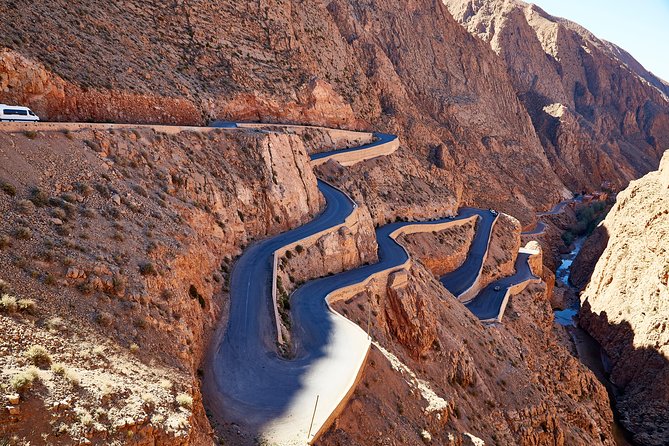
This tour is built like a “journey-first” circuit. You’re not just jumping from one landmark photo to another. You’ll cross the High Atlas, thread through valleys and kasbah towns, then end with the Sahara experience at Erg Chebbi before returning to Marrakech.
The route makes sense if you want variety in a short time. One day you’re in palm groves and rose valleys; the next you’re walking in canyon walls at Todgha; the next you’re riding camels at sunset and sleeping near the dunes. You also get a good mix of structured time and flexible stops, thanks to the English-speaking driver and the plan that includes pauses along the way.
The big value isn’t only the sights. It’s how the days are staged: the desert night is the centerpiece, but it’s supported by strong cultural stops so the whole trip feels earned instead of rushed.
You can also read our reviews of more evening experiences in Marrakech
Day 1: High Atlas to Ait Benhaddou, then Skoura and the Dades Valley night
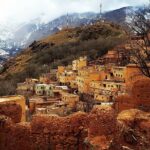
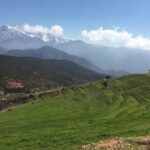
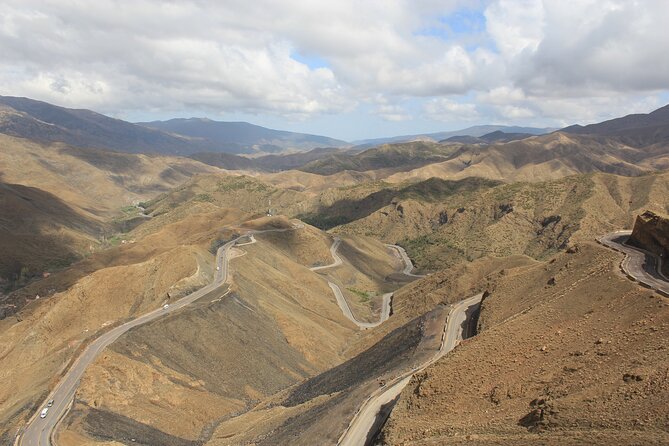
Day 1 starts with departure from Marrakech in the morning and a crossing of the High Atlas by the Tizi n’Tichka pass (2260 m). This is one of those drives where the road itself becomes part of the experience. You’ll travel toward the fortified ksar of Ait Benhaddou, known for its dramatic Kasbah shapes and film connections.
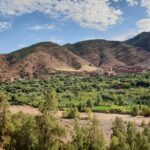
After lunch, you continue on to Dades through Ouarzazate, the palm grove of Skoura, and the Valley of the Roses. That sequence matters because it gradually shifts from mountain pass views to softer, agricultural scenery, so you don’t go straight from cliffs to desert without transition.
You’ll finish the day spending the first night in the Dades area. Practical note: Day 1 is the first “real day” of travel after Marrakech, so it helps if you’re okay with the early start and the travel time while everyone gets used to the rhythm of the route.
Day 2: Dades Gorges, Todgha Canyon hike, then camel sunset at Erg Chebbi
Day 2 is where the itinerary starts stacking up big moments. After breakfast, you head for the Dades Gorges via the Road of 1000 Kasbahs, passing through colorful Berber villages. The aim here is simple: you’re moving through inhabited areas rather than only seeing roadside views.
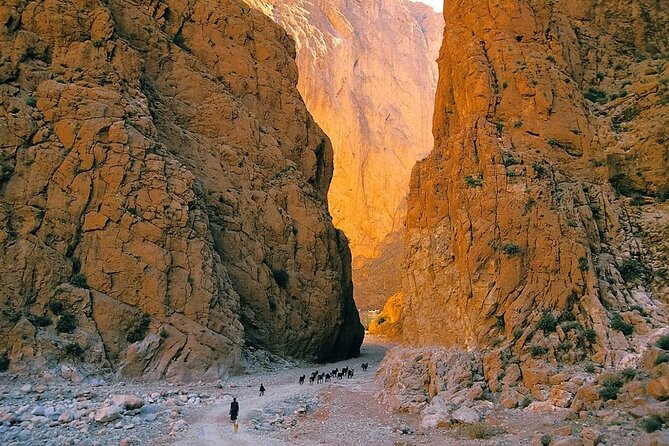
Next comes Tinghir and its palm grove. Then you reach the Todgha Gorge, where you hike along canyon paths rising about 300 m above sea level. This is the most “active” part of the tour—worth doing with sturdy shoes and a steady pace, since you’re walking inside a canyon environment.
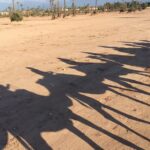
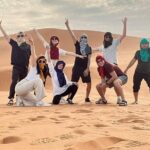
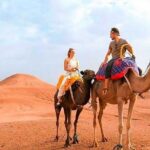
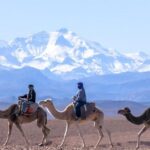
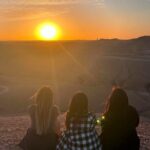
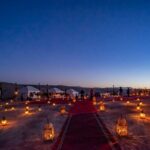
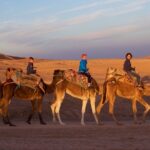
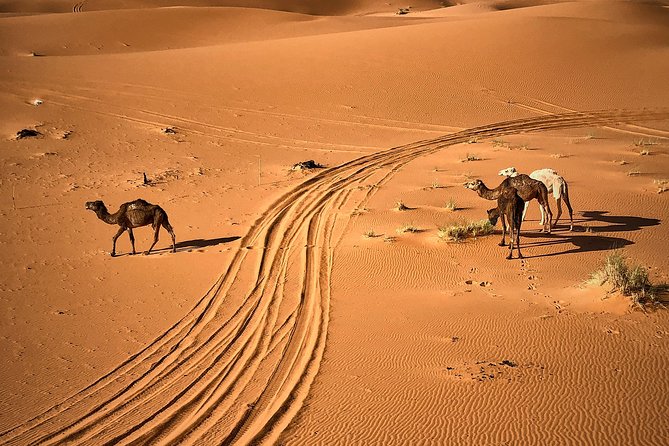
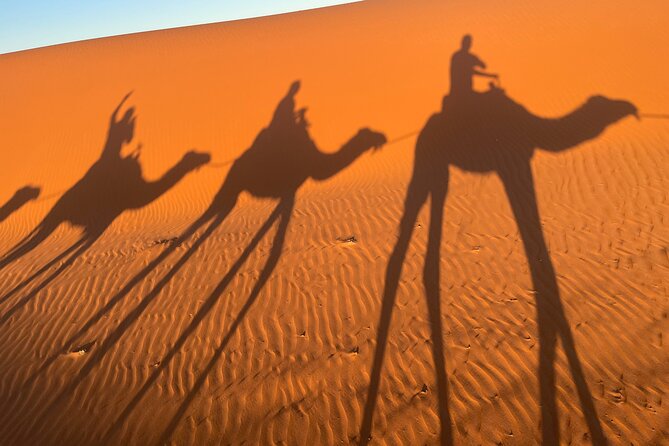
From Todgha you continue to Erg Chebbi in the Merzouga Sahara region. Once you arrive, you get time for lunch on the way and then the desert centerpiece: an approximately 1.5-hour camel ride to watch the sunset. After that, you head to the camp in or near an oasis area.
Overnight is part of the magic: you’ll sleep under nomadic tents or outside under the stars, depending on what the camp setup offers during your specific night. This is also where the tour’s comfort choice stands out. The included camp is described as deluxe, with private tents and ensuite bathroom plus shower.
Day 3: Sunrise dunes, showers and breakfast, then Rissani souks and the Draa Valley to Ouarzazate
You start Day 3 early enough for a sunrise moment on the dunes. The plan calls for getting up and climbing the sand dunes to admire sunrise, then returning for camels, moving back to the dune line, and using the camp’s setup—shower and breakfast—before you head onward.
Then you shift back into “souks and valleys” mode. The route goes through Rissani, where you can stop and visit traditional souks described as among the largest in southern Morocco. If you like markets, this is one of the more human-scale breaks—less about monuments, more about local commerce and everyday life.
After Rissani, you continue into the Draa Valley, noted for its millions of palm trees. That’s a long stretch of scenery with a steady feel, which also gives you a breather from constant stops. In the afternoon you arrive in Ouarzazate, where you spend the night.
This day is a good example of why the tour works: it doesn’t end the desert and then abandon the rest of Morocco. It uses the desert night as a peak, then keeps your momentum with markets and valley roads that feel connected to the region.
Day 4: Ait Benhaddou World Heritage and Telouet Kasbah el Glaoui on the way back to Marrakech
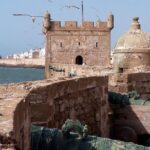
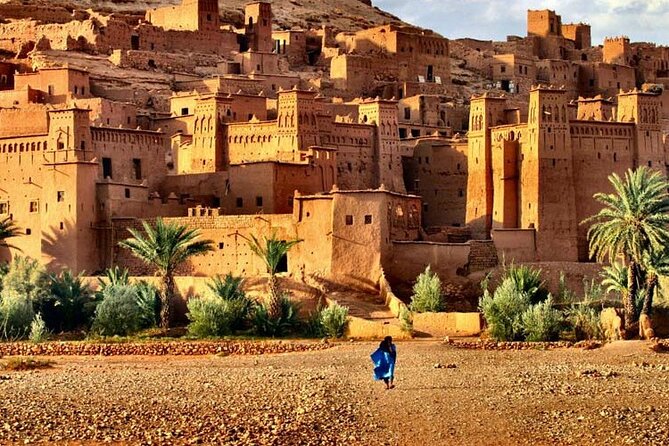
The final day starts with a focus on the fortified village again, but in a more “finish strong” way. You move to Ait Benhaddou and visit it as a World Heritage site. It’s one of those places where the shape of the architecture tells a story even before anyone explains it—thick walls, maze-like streets, and kasbah towers that dominate the horizon.
From there, you continue toward Marrakech with a detour to Telouet, a traditional Berber village in the High Atlas region. You’ll visit Kasbah el Glaoui before crossing back over the High Atlas toward Marrakech.
The point of Day 4 isn’t to cram in one more desert moment. It’s to make sure the kasbah portion of the route lands properly before you return to the city. If you came for scenery plus culture, this is a satisfying wrap.
A few more Marrakech tours and experiences worth a look
Price and Value: Is $464.41 per person fair for this route?
At $464.41 per person for a 4-day/3-night trip, the value depends on what you compare it to.
Here’s what’s included that pulls the price into a more reasonable range:
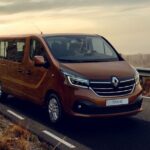
- Private transportation in an air-conditioned vehicle
- English-speaking driver
- Three nights’ accommodation plus deluxe camp for the desert night
- Camel trekking in the desert (with a stated option to skip the camel ride and go by SUV to the camp)
- Most meals: breakfast (3) and dinner (3)
- Flexible stops and pauses
What’s not included is also clear: lunch and extra drinks with included meals.
So for value, the key question is whether you’d otherwise pay separately for driver, vehicle, desert transport, camel ride logistics, and multi-night lodging. This itinerary bundles those into one plan. If you’re traveling as a couple or small group and want comfort (especially with the private tent and ensuite shower during the desert night), the price starts to feel like it’s doing real work for you.
The other side of the value argument is time. You’re paying with hours in a car. The route makes sense if you’re okay with that trade: you’ll see more regions than you would on a short, single-area desert getaway.
The Guide Factor: Why Ismail’s name keeps coming up
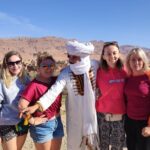
One of the most consistent themes in the feedback is the guide. The name you’ll see most is Ismail (including “Ismail Naceur” in one note). People describe him as:
- Showing up on time and driving with a steady focus
- Keeping the long drives feeling easier with humor and good pacing
- Explaining what you’re seeing and answering questions
- Being flexible, including adapting well to kids
- Handling real-life changes with understanding when emergencies came up
A trip like this succeeds or fails based on the driving and the tone. Roads between Marrakech, the High Atlas passes, the valleys, and the desert can be long and tiring. A driver who stays calm, communicates clearly in English, and manages timing well is a major part of why the overall experience lands well.
If you value a guide who feels more like a helpful partner than a strict itinerary enforcer, this tour is aligned with what people report about Ismail’s style.
Camel Ride Option, Desert Camp Comfort, and What to Expect at Night
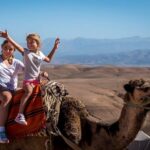
Camel rides are included, but the tour also offers a choice: you can skip the camel ride and go to the camp by SUV instead. That’s a useful option if you want the desert night without the physical aspect of mounting and sitting on a camel for that ride.
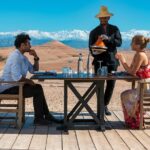
Once you reach the camp area, the setup matters. The included desert overnight is described as deluxe, with private tents and an ensuite bathroom and shower. That’s not just a perk. It changes the way you feel after a long travel day. Instead of “roughing it” with basic sanitation, you can clean up and actually sleep better.
You might spend the night under nomadic tents or outside under shooting stars, depending on the camp arrangement. Either way, you’re centered on Erg Chebbi’s dunes, and the tour’s timing is designed to place the best lighting—sunset and sunrise—right where it counts.
Timing, Weather, and July-August Heat Reality Check
This experience requires good weather. If it’s canceled because of poor conditions, you’ll be offered a different date or a full refund. That matters for the desert portion, where visibility and route planning are more sensitive.
The other big weather note is the calendar. July and August are very hot in Morocco, and the tour warns that temperatures can be unbearable even for adults. If you’re planning in mid-summer, you’ll want a realistic mindset: lots of sun, more strain outdoors, and fewer chances to feel comfortable during midday walking.
Day 2 includes a canyon hike and Day 3 includes dune sunrise, both outside at likely bright hours. So your best strategy is timing your effort: do the early-morning stuff when it’s cooler, and take the provided pauses seriously.
Who This Tour Fits Best (and who might want a slower plan)
This is a strong choice if you want a private itinerary and like seeing multiple Moroccan regions without bouncing between hotels on your own. It also fits well if you care about the desert night being more comfortable than basic camp conditions, given the private tent and ensuite shower.
It can also work well for families, since feedback includes notes about the guide adapting to children.
The main mismatch is for people who hate long road hours. Some feedback highlights that you’ll be in the car many hours. This trip is built on travel days stacked with sight stops, not on a slow, relaxed pace.
If your ideal Morocco trip is mostly city strolling with minimal driving, you’ll likely find the schedule heavy.
Should You Book This Marrakech to Marrakech Desert Tour?
Book it if you want:
- A full route: Marrakech → High Atlas → Ait Benhaddou → Dades/Todgha → Erg Chebbi dunes → back to Marrakech
- A proper desert night with comfort (private tent and ensuite shower)
- The convenience of private transport plus English-speaking guidance
- The chance to see sunrise and sunset in the dunes, not just one quick stop
Think twice if:
- You’re sensitive to heat and you’re traveling in July or August
- You strongly prefer short travel days and hate spending many hours on the road
- You’re not comfortable with an outdoor hike in a gorge setting
If you’re in the sweet spot—curious, practical, okay with driving time, and excited for Erg Chebbi—this is the kind of itinerary that leaves you with that Morocco feeling: mountains, kasbahs, and the Sahara all in one line.
FAQ
Where does the tour start and what time does it begin?
The tour starts at Hôtel Restaurant Café de France J2G7+G2G near Jamaa el-fnna in Marrakech. The start time is 8:00 am.
How do I get back to the start point at the end of the tour?
The activity ends back at the same meeting point in Marrakech.
Is transportation included?
Yes. The tour includes private transportation in an air-conditioned vehicle.
Does the tour include the camel ride?
Yes. Camel trekking is included in the desert portion.
Can I skip the camel ride if I prefer not to ride a camel?
Yes. There is a possibility to skip the camel ride and go to the camp by SUV.
What meals are included?
Breakfast is included for 3 mornings and dinner is included for 3 evenings. Lunch is not included.
What about drinks with meals?
Extra drinks are not included with the included meals.
Is there vegetarian food available?
Yes. A vegetarian option is available. You should advise at the time of booking if you need it.
What weather conditions do I need for this trip?
This experience requires good weather. If it’s canceled due to poor weather, you’ll be offered a different date or a full refund.
Is cancellation free?
Cancellation is free up to 24 hours in advance for a full refund. If you cancel less than 24 hours before the start time, the amount you paid will not be refunded.