REVIEW · MARRAKECH
Arabic Calligraphy Workshop Marrakech
Book on Viator →Operated by ZIZI ESSAID · Bookable on Viator
A pen stroke can turn into real art. This Arabic Calligraphy Workshop Marrakech is a focused, hands-on class where you start with shapes and end with something personal: your name beautifully written. I love the patient instruction and the fact you’re not just watching. I also love the keepsakes you walk out with, like expression bookmarks and calligraphy done for you. One thing to consider: it’s only about two hours, so you’ll get strong basics and a few finished pieces, not months of practice.
The workshop runs out of a central spot by the Marrakech Museum, so it fits naturally into a day of wandering the medina. The pacing is built around tools, letter forms, and composition, with practice taking the lead—exactly what you want if you’re hoping to leave with actual results, not just nice photos. The teaching team includes Zizi Essaid, and other instructor names like Houcine, Essaid, and Said have come up in the teaching crew, so you’ll often get a mix of skill and encouragement.
In This Review
- Key Things to Know Before You Go
- Why This Workshop Works So Well in Marrakech
- A small caution on expectations
- Finding the Marrakech Museum Meet Point (Place Ben Youssef)
- What the meeting point vibe means for you
- The Class Flow: From History to Your First Real Letters
- 1) Intro to Arabic calligraphy
- 2) Tools: pens and ink
- 3) Basic forms: circles, straight lines, curves
- 4) Letters and technique
- 5) Composition and styles
- 6) Practical: practice is the main event
- The Qalam Pen Moment: Learning Grip and Stroke Control
- Your Name and Expression Bookmarks: The Keepsake Part
- Your name calligraphed
- Bookmarks with expressions you choose
- A note on the workshop atmosphere
- Teacher Style and Small-Group Attention
- Price and Value: Is $63.88 Worth It?
- Who will feel the value most
- Practical Tips for a Smooth 3:00 pm Workshop
- Who Should Book This Workshop (And Who Might Skip)
- Should You Book This Arabic Calligraphy Workshop in Marrakech?
- FAQ
- FAQ
- Where is the Arabic calligraphy workshop meeting point?
- What time does the workshop start?
- How long is the workshop?
- How much does it cost?
- What do I get at the end of the workshop?
- What happens during the class?
- Is there a group size limit?
- Can I use a mobile ticket?
- Are service animals allowed?
Key Things to Know Before You Go
- Personal keepsakes: you can take home bookmarks with expressions you choose, plus calligraphy work featuring your name.
- Practice-forward class: you’ll spend most of the time actually writing, not only listening.
- Hands-on tools: you’ll work with pens and ink, including a bamboo Qalam mentioned in class.
- Small group feel: with a maximum of 10 travelers, it’s easier to get attention and correct grips early.
- Central meet point: it starts near the Marrakech Museum at Place Ben Youssef, so you’re not stuck crossing town.
Why This Workshop Works So Well in Marrakech
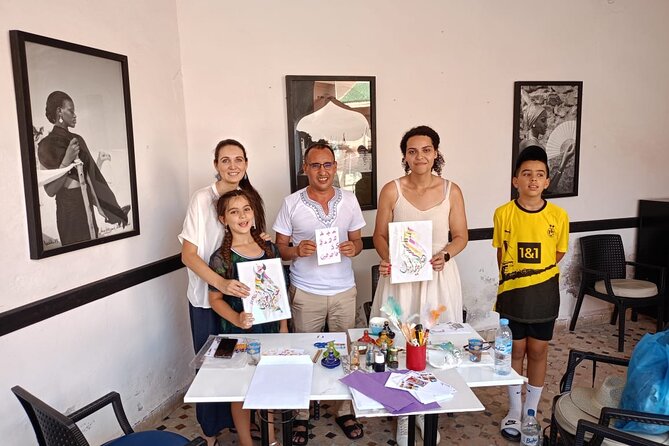
Marrakech is loud, fast, and full of visual noise. This workshop is the opposite of that. You slow down, hold a pen, and build letters stroke by stroke until they look intentional. It’s a good match for the city’s design sense, from carved plaster to tiled zellige—calligraphy fits right in.
In just around two hours, you’ll cover the basics in a way that makes sense for non-experts. The class starts with what Arabic calligraphy is and what it means, then moves into tools and letter forms. After that, you do the hardest part: practice. One of the best parts is that you’re learning to write, not just recognizing styles.
You also leave with something personal. You get your name calligraphed by the master of the workshop, plus bookmarks with expressions such as happiness, life is beautiful, live your life, wisdom, fidelity, love, dream, or other phrases you pick. That matters more than you’d think. In a city full of souvenirs, this is a keepsake you didn’t buy off a shelf. You helped make the “language” part of it.
A few more Marrakech tours and experiences worth a look

A small caution on expectations
Because the time is short, the goal is fundamentals and a few finished pieces. If you’re hoping to master multiple calligraphy styles perfectly in one sitting, you’ll likely feel the clock a bit. But if you want a real introduction and a memorable result, this class hits the sweet spot.
Finding the Marrakech Museum Meet Point (Place Ben Youssef)
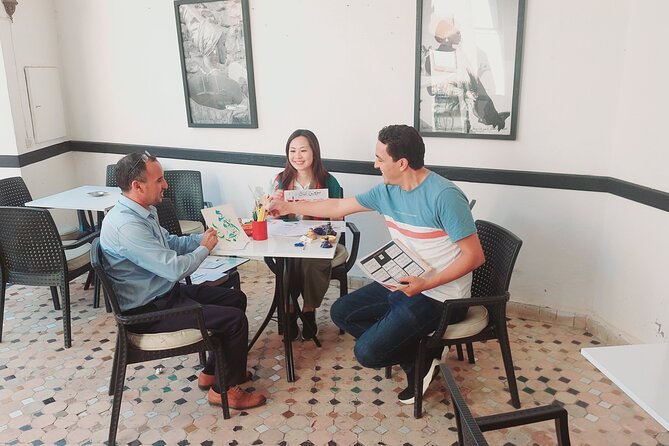
The workshop starts at Marrakech Museum, Place Ben Youssef, Marrakech 40000. That’s a smart location. It’s central, and it’s near public transportation, which means you’re not forced into a long scramble before your class.
Start time is 3:00 pm, and the activity ends back at the meeting point. That simple “start and end nearby” setup makes it easy to pair the workshop with other nearby stops—before or after, you can keep your schedule smooth instead of crisscrossing the city.
You’ll also use a mobile ticket, and confirmation is received at booking. In practical terms, it means you should have your phone charged and your booking info handy. It’s a small thing, but it helps you get in quickly.
What the meeting point vibe means for you
A museum area tends to be calmer than the deepest parts of the medina. For this kind of delicate activity, that’s a plus. You’ll spend less energy finding the right door and more time learning how to hold the pen and form letters.
The Class Flow: From History to Your First Real Letters
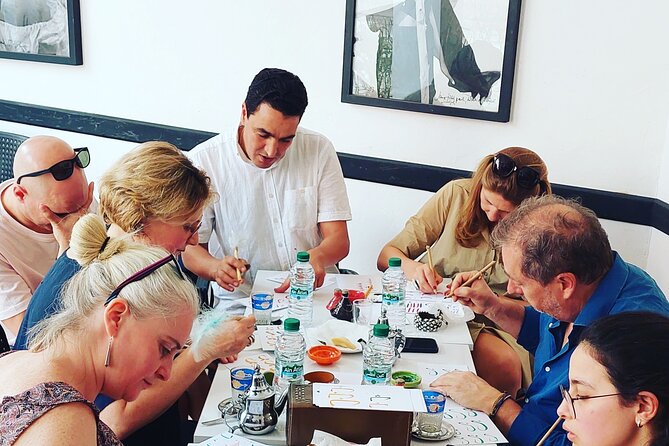
Here’s how the workshop is structured, and why each step matters.




1) Intro to Arabic calligraphy
You begin with a brief introduction to the history and meaning of Arabic calligraphy. That doesn’t have to be “lecture time.” Done well, this kind of intro helps your brain understand why the strokes matter. It’s also a quick way to move from thinking of calligraphy as decoration to seeing it as a system.
You may also get help connecting letters to their sounds. One class account described learning some of the Arabic abjad and letter sounds. If you’ve studied Arabic before, this can be the missing link between spelling and how writing is actually shaped.
2) Tools: pens and ink
Next comes familiarity with the tools—pens and ink. If you’ve ever tried calligraphy at home, you know how easy it is to get frustrated. Too much pressure, wrong angle, ink that behaves oddly, and suddenly the stroke looks messy.
That’s why this step is valuable. You’re learning the “why” behind technique before you start writing your own shapes.
3) Basic forms: circles, straight lines, curves
Then you practice the building blocks: circles, straight lines, and curves. These are not random warm-ups. They’re the skeleton of many letter forms. Once your hand learns these motions, the letters become more logical.
This is where you start to feel the payoff. A good calligraphy class makes the writing feel like drawing with rules.
4) Letters and technique
After the basics, you learn how to form Arabic letters using the right techniques. This is the part where patience counts. If your grip is off, it shows immediately. Getting correction early saves time later.
Some participants specifically noted learning how to hold the pen properly—so don’t underestimate how much the grip affects results.
5) Composition and styles
You also explore different compositional techniques and styles of Arabic calligraphy. Even if you don’t master all of them, understanding what changes composition (spacing, placement, balance of strokes) makes your final piece look intentional.
This step is the bridge between “I can form letters” and “I can make something that looks good on paper.”
6) Practical: practice is the main event
Finally, practical time dominates. That’s the right design. You learn by doing, and you improve by repeating. You’ll have a chance to get feedback while your strokes are still forming.
If you’ve got a creative streak, this is also the moment where it starts to feel fun, not technical.
The Qalam Pen Moment: Learning Grip and Stroke Control
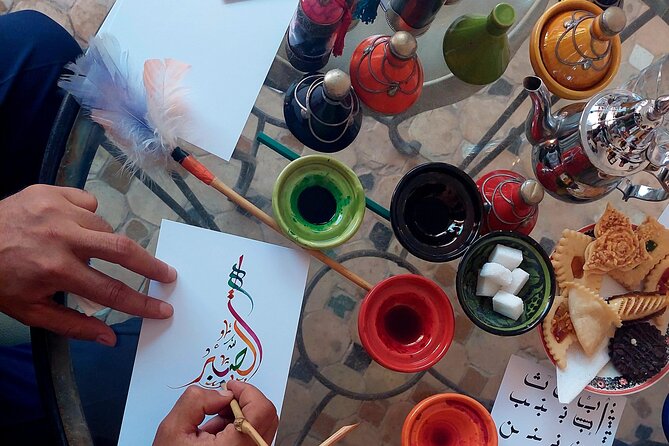
In at least one class experience, the bamboo Qalam pen got a special mention. That’s important because Qalam pens tend to behave a bit differently than typical modern pens. The angle and pressure can change how thick or thin your line looks.
What you should take away from this, even without knowing the specifics of the pen: technique is mostly about control. You’ll learn how to hold the pen so your wrist and fingers do the job instead of fighting the tool.
One participant shared that they had studied Arabic for years but only then realized how to hold the pen properly. That’s exactly what you should hope for from this class: a small correction that instantly upgrades your results.
Also, if you’ve got ink fear—like you’re worried you’ll ruin paper—don’t. The workshop format is built to let you try. You’re practicing in guided conditions.
Your Name and Expression Bookmarks: The Keepsake Part
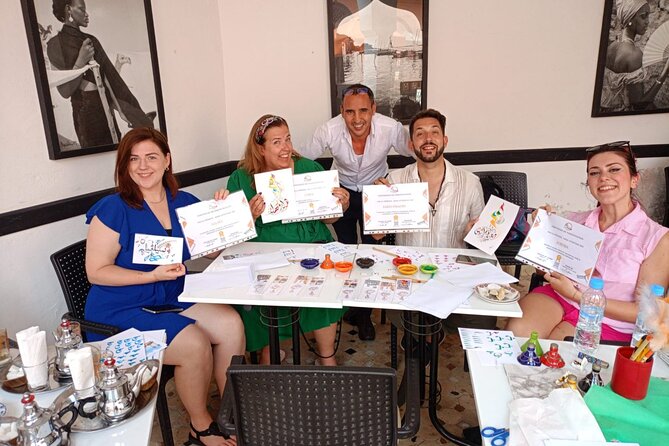
Let’s be honest. This is Marrakech, and you can buy plenty of decorative things. The twist here is that the main take-home items are personalized and tied to what you learn.
Your name calligraphed
You’ll have your name beautifully calligraphed by the master of the workshop. That turns the class into a personal souvenir, not a generic product. It’s also a nice conversation starter when you get home: you can explain that the writing came from learning the structure of letters and strokes.
Bookmarks with expressions you choose
You’ll also leave with bookmarks featuring beautiful expressions of your choice—options mentioned include happiness, life is beautiful, live your life, wisdom, fidelity, love, dream, and others. Even if you’re picky, choosing an expression is part of the fun. You’re matching calligraphy to a meaning, which is exactly what calligraphy tends to do best.
A note on the workshop atmosphere
One class account described tea of mint and pastel sweets as part of the experience. That sort of welcome matters more than people think. It puts you in a calm mood for fine-motor work. You’re not rushed out; you’re treated as someone learning an art, not a shopper stopping by for entertainment.
Teacher Style and Small-Group Attention
The workshop is set up for a maximum of 10 travelers. That’s a real advantage for learning a physical skill like writing. In a larger group, you’d get stuck watching while someone else gets correction. Here, there’s room for the teacher to notice what you’re doing.
The teaching style has a strong “supportive and patient” theme in the feedback. Names that show up as teachers include Zizi Essaid, Houcine, Essaid, and Said. Across these different names, the consistent idea is encouragement plus technique—helping you fix your strokes early rather than letting mistakes harden.
One memorable setup mentioned a tiny group where only two people attended, leading to extensive practice and personalized attention. You can’t count on a group being that small, but it’s a good sign. If your day ends up on the quieter side, you’ll likely get more time to write and refine.
Price and Value: Is $63.88 Worth It?
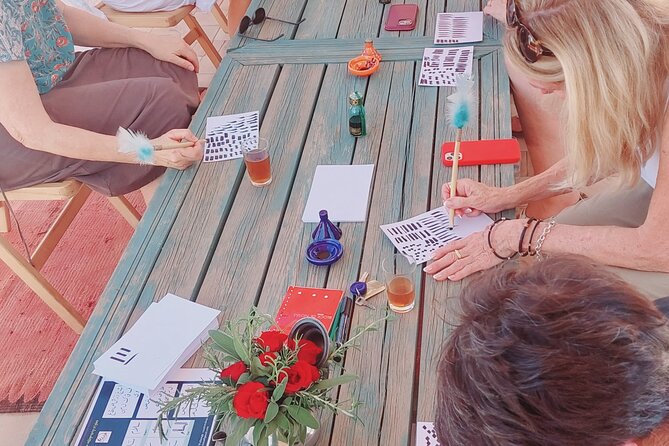
The price is $63.88 per person for about two hours, with a mobile ticket. On paper, that’s not cheap—but it can still be good value if you’re getting three things:
1) guided instruction for an art skill
2) personalized outcomes (your name calligraphed)
3) take-home pieces (expression bookmarks)
You’re paying for an experienced instructor’s time and feedback, plus the materials and output that leave you with something finished. In Marrakech, a lot of “experience” tours are basically guided wandering. This one is different: you come away with a product of your own practice and a personal souvenir that’s hard to replicate at home.
Who will feel the value most
If you like hands-on learning—sketching, crafts, pottery, cooking—you’ll likely feel the value quickly. If you mainly want a photo stop, you might find it less exciting than a performance or a market tour. Still, the personal keepsakes make it more than a quick demo.
Practical Tips for a Smooth 3:00 pm Workshop
A few simple moves will make the session easier and more enjoyable:
- Arrive a little early so you can settle and start writing without rushing.
- Bring your booking details on your phone for the mobile ticket check.
- Wear something comfortable that lets you move your wrist and hand freely. Calligraphy needs relaxed control.
- Be ready to practice. The most progress comes from doing what the instructor asks, even if your first strokes feel awkward.
Because it’s 3:00 pm, plan your day so you’re not rushing from a late lunch or a distant excursion. The class is about focus, and you’ll get better results when you’re not running on stress.
Who Should Book This Workshop (And Who Might Skip)
This is a strong fit if you want a calm, meaningful activity in Marrakech.
You’ll likely enjoy it if:
- you want hands-on creative practice
- you like personal keepsakes that are tied to your name or chosen expression
- you’re traveling with kids or teens and want something educational yet not overly rigid (one note mentioned it works well for both adults and kids)
You might skip it if:
- you dislike pen-and-paper activities or fine-motor tasks
- you’re hoping for a long, deep training session (this is about basics and guided practice, not advanced mastery)
Should You Book This Arabic Calligraphy Workshop in Marrakech?
I think it’s worth booking if you want something different from the usual Marrakech itinerary. The best part is the combination of practical instruction and personal results—your name written in calligraphy, plus bookmarks with chosen expressions. It’s also scheduled in a way that’s easy to plug into your day, starting near the Marrakech Museum around 3:00 pm.
If you’re on the fence, decide based on this: do you want to leave with a meaningful souvenir you helped create? If yes, book it. If you just want a quick cultural photo, you might prefer something more passive.
One more practical note: it’s generally easy to manage because free cancellation is available if you cancel at least 24 hours in advance, so you can adjust if your Marrakech plans change.
FAQ
FAQ
Where is the Arabic calligraphy workshop meeting point?
It starts at Marrakech Museum, Place Ben Youssef, Marrakech 40000, Morocco.
What time does the workshop start?
The start time is 3:00 pm.
How long is the workshop?
The duration is about 2 hours.
How much does it cost?
The price is $63.88 per person.
What do I get at the end of the workshop?
You’ll have your name calligraphed by the master of the workshop, and you’ll leave with bookmarks featuring expressions you choose.
What happens during the class?
You’ll get an introduction to Arabic calligraphy, learn about tools, practice basic forms (circles, straight lines, curves), learn letter formation, explore composition and styles, and spend most of the time in practical writing.
Is there a group size limit?
Yes. The workshop has a maximum of 10 travelers.
Can I use a mobile ticket?
Yes, the tour uses a mobile ticket.
Are service animals allowed?
Yes, service animals are allowed.