REVIEW · MARRAKESH
Marrakesh: Private Half-Day Walking Guided Tour
Book on GetYourGuide →Operated by Get Marrakech · Bookable on GetYourGuide
Marrakech gets real when you walk it. This private half-day route strings together the places that define the city: Ben Youssef Madrasa for old-school Islamic craftsmanship, and Jemaa el Fna for the Medina’s big stage. You’ll also hit the iconic Koutoubia area, slip through busy markets, and finish in the Mellah.
I like how the tour turns architecture and everyday life into something you can actually see. The Ben Youssef stop is heavy on details—zellij tilework, stucco work, and carved wood—and your English guide (often Ali or Mohammed) talks in plain human terms, not dusty facts.
One thing to plan for: the best sights on this route cost extra, and you’ll need cash. Bahia Palace is 10€ and Medersa Ben Youssef is 5€, and the tour notes they only accept cash.
In This Review
- Key highlights you’ll feel fast
- A 4-hour plan that fits Marrakech without frying your feet
- Meeting at Café France: the small detail that prevents big stress
- Jemaa el Fna: the square you understand better after a guide
- Koutoubia Mosque: see the landmark and get the proper frame
- Ben Youssef Madrasa: where the details do the talking
- Souk Semmarine: shop with purpose, not just impulse
- Bahia Palace: a luxurious residence built by Si Moussa
- The Mellah: Jewish Quarter, spice market, and cultural context
- Why guides like Ali and Mohammed change the whole experience
- Price and value: what you really pay for at $39
- The one risk to keep in mind: no-show happens
- Who should book this private Marrakech walk
- Should you book it?
- FAQ
- How long is the Marrakech private walking guided tour?
- What’s included in the price, and what costs extra?
- How much are the entry fees for the main sights?
- Do they accept credit cards or cash?
- Where does the guide meet you?
- Is it suitable for wheelchair users?
Key highlights you’ll feel fast
- Craftsmanship first at Ben Youssef: zellij, stucco, and carved wood inside an Islamic college.
- Jemaa el Fna, up close: a guided look at the square’s vendors and street performers.
- A smart, walkable mix: palace, mosque landmark, souk browsing, then the Mellah.
- Souk Semmarine shopping momentum: lamps, handcrafts, and traders in the Medina’s biggest market.
- Bahia Palace with context: built in 1894 by Si Moussa, the grand vizier—luxury with stories behind it.
- English private guiding: outgoing guides who keep things moving and answer questions.
A 4-hour plan that fits Marrakech without frying your feet
This is a private half-day walk, priced at $39 per person and lasting about 4 hours. That matters because Marrakech moves fast—one street can feel like a shortcut and the next turn can feel like a maze—so having one guide helps you keep your bearings without spending the day charting things yourself.
You start at Hôtel Restaurant Café de France (the guide meets at the gate), with pick-up available if your hotel/riad is inside the Medina. Expect mostly walking in old lanes, so comfortable shoes are non-negotiable.
Timing is built around a “look, then move” rhythm. You’ll get short guided orientation at the central square, more focused time at the Madrasa and Bahia Palace, and lighter pass-by moments at Koutoubia and Souk Semmarine.
Also, the tour includes skip-the-ticket line for the sights where tickets apply. That can save real time when entry lines get ugly.
You can also read our reviews of more walking tours in Marrakesh
Meeting at Café France: the small detail that prevents big stress
Your guide waits at the Cafe France Gate, so you don’t have to hunt around for a meetup point. If you’re staying in the Medina, pick-up is listed, which is a nice perk because you’ll start walking closer to the action.
I’d treat the first few minutes like a check-in. Be ready to go when your guide finds you, especially if you’re heading into the most crowded areas like Jemaa el Fna. In a city this busy, arriving late by even a little can mean losing the flow.
Jemaa el Fna: the square you understand better after a guide
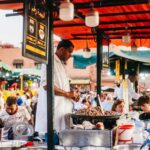
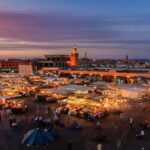
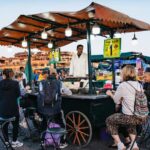
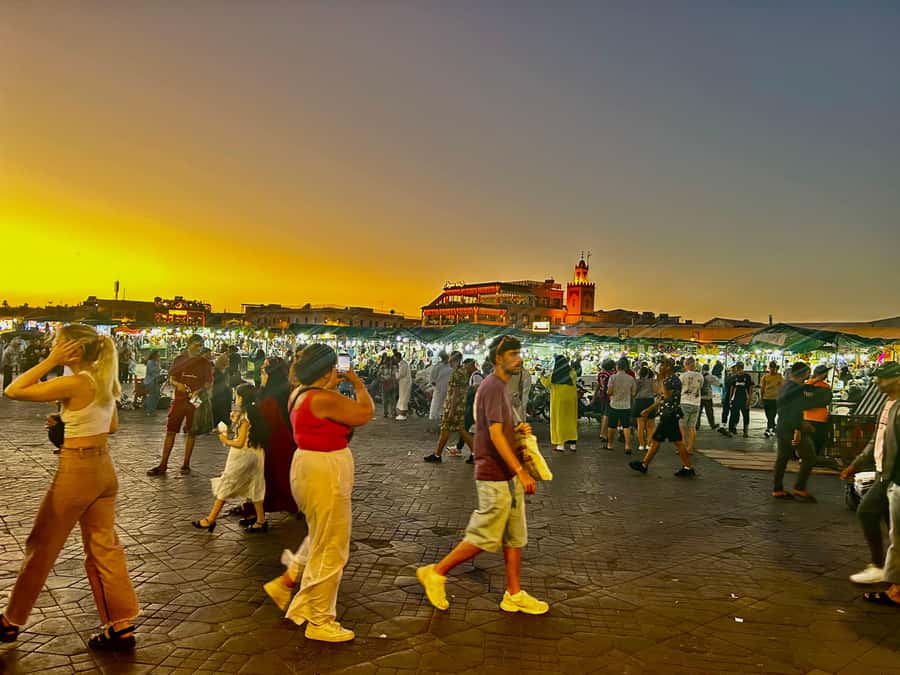
Jemaa el Fna is more than a postcard stop. It’s the kind of place where people sell things, performers work the crowd, and the whole square feels like one living show.
On this tour you spend about 20 minutes there with a guide. You’re not just standing and staring—you’re learning what you’re seeing: vendors, medicine men, people playing old-school entertainment like snake charmers and monkeys, plus story tellers and henna makers.
Here’s what I’d do with that guided window: use it to watch the patterns. You’ll get a sense of where the action clusters and where you can step back and observe. Then you’ll be able to keep your day moving without feeling lost or overwhelmed.
Koutoubia Mosque: see the landmark and get the proper frame
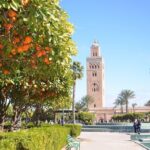
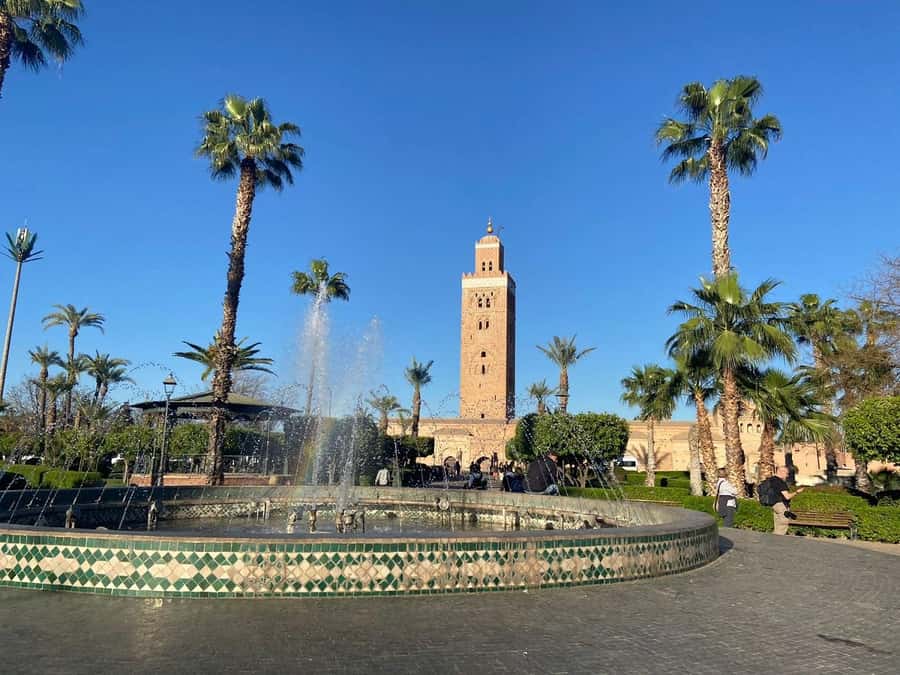
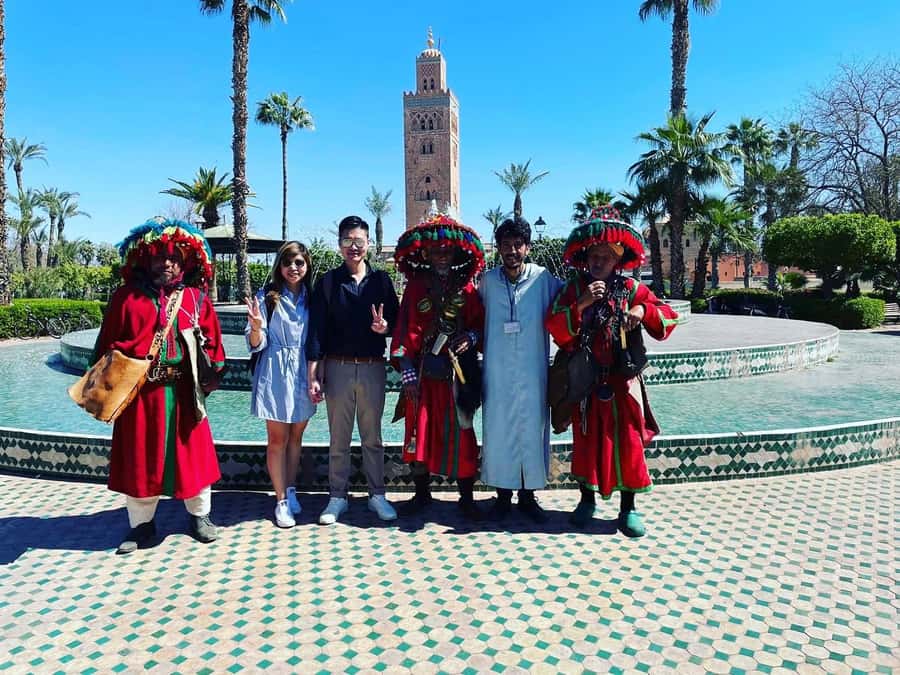
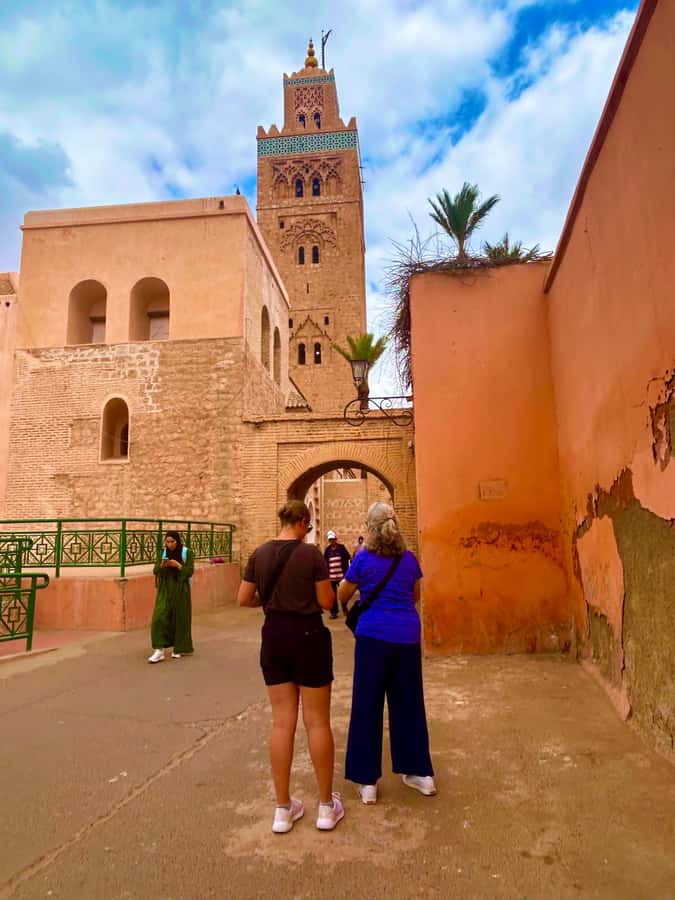
You’ll pass by the Koutoubia Mosque for about 20 minutes. It’s the main landmark in Marrakech, built in the 12th century, and it’s one of the oldest and most impressive mosques in the old Medina area.
Even with a short stop, this is a good moment to pause because the guide can help you understand why the mosque is treated like a focal point—historically important, visually recognizable, and tied to the city’s identity.
Since you’re not spending all morning at one site, you’ll move on before the square and souk energy wears you down. That pacing is one of the tour’s strengths.
Ben Youssef Madrasa: where the details do the talking
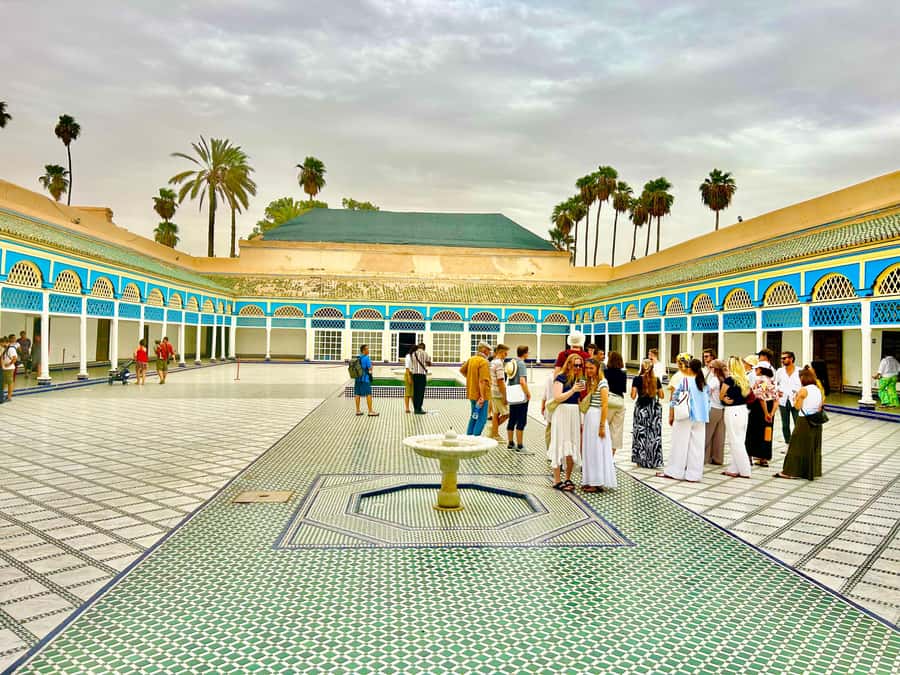
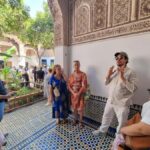
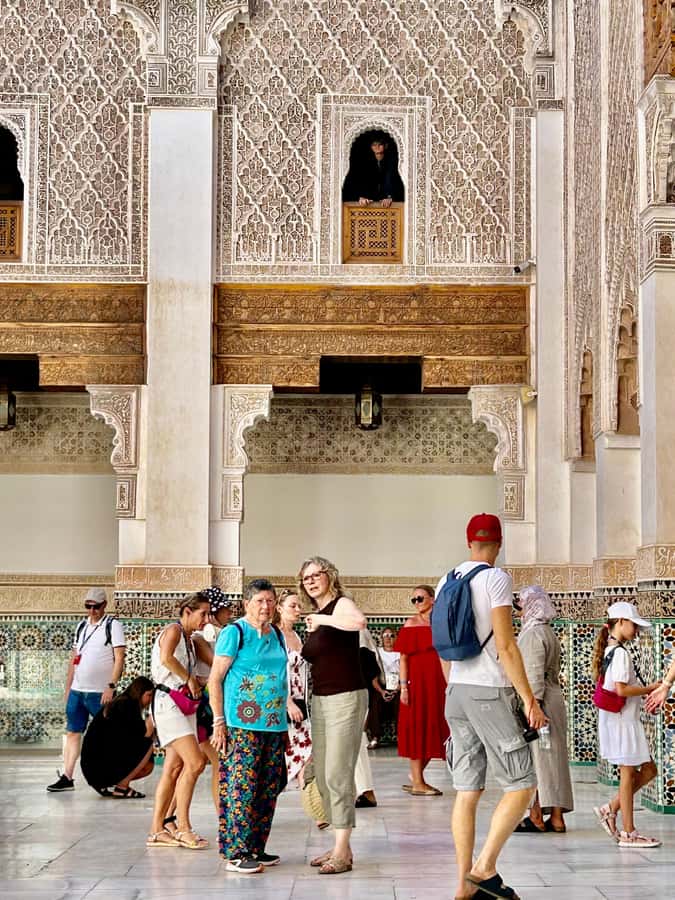
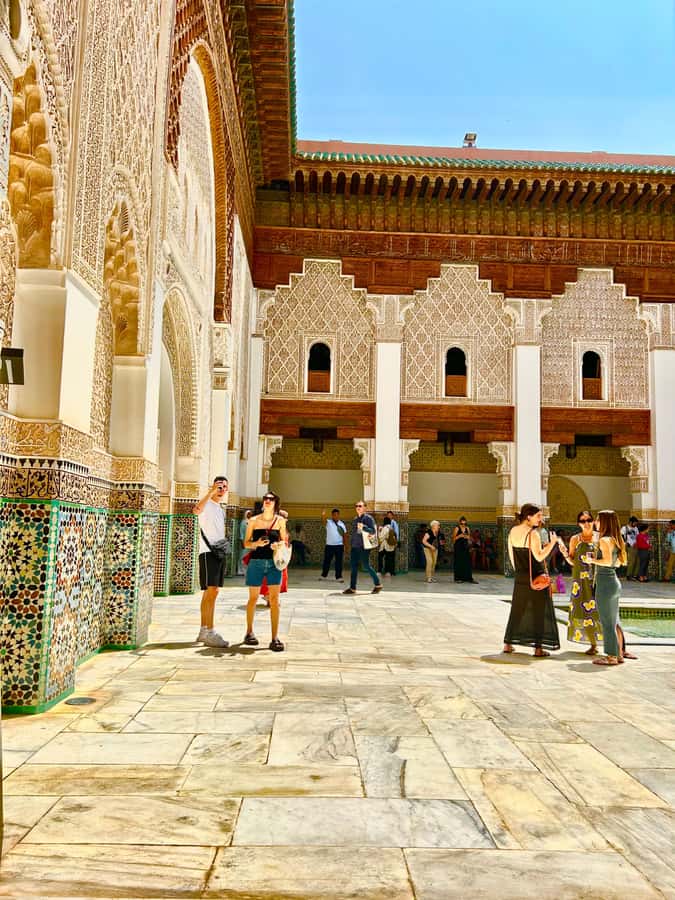
The Ben Youssef Madrasa (Medersa Ben Youssef) is the stop that often makes people slow down. This historic Islamic college sits in the heart of the Medina, and it’s famous for its craftsmanship—zellij tilework, intricate stucco, and carved wood.
You get a guided visit of about 30 minutes, which is enough time to notice what matters without rushing. I love this kind of stop because it trains your eye. After a few minutes you stop seeing it as one big building and start reading it like a puzzle: patterns in the tilework, delicate surface textures, and the way the decoration keeps drawing you inward.
Entry is extra: 5€, and the notes say they only accept cash. If you’re someone who hates last-minute ATM hunts, plan your cash early before you get deep into the Medina.
This is also a great place to learn how the building functioned—not just how it looks. As an Islamic college, it’s tied to education and religious life, which helps the artistry make more sense.
You can also read our reviews of more guided tours in Marrakesh
Souk Semmarine: shop with purpose, not just impulse
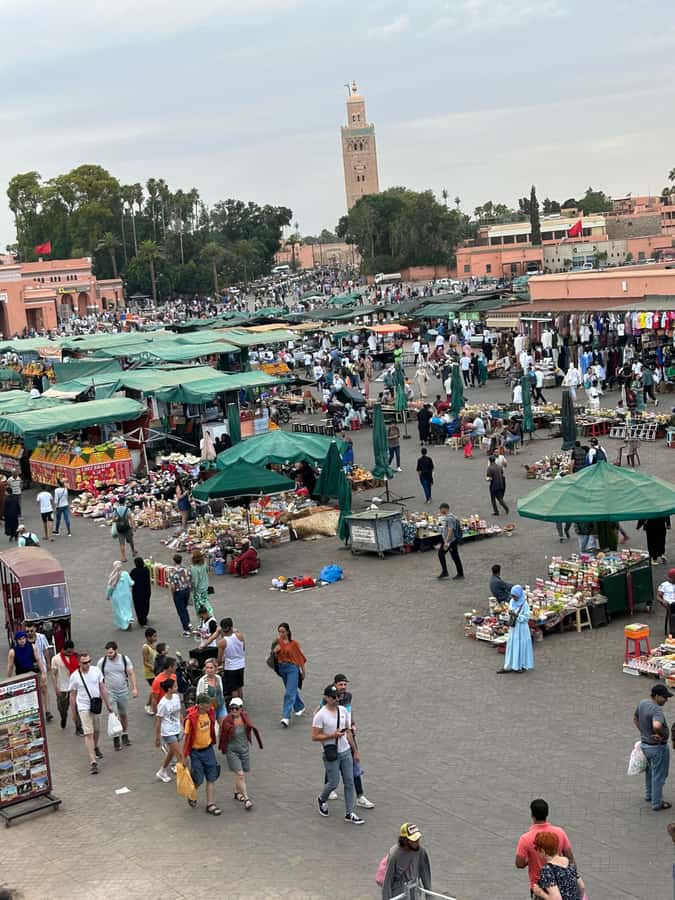
Souk Semmarine is one of Marrakech’s most useful market stops, especially if you want souvenirs that feel local rather than mass-produced. It’s described as the largest market in Marrakech, and during your time there you’ll mainly pass through with the guide for about 15 minutes.
Expect a dense mix of lamps, handcrafts, and traders. This is exactly the kind of souk where prices can vary, so the value is in comparison. Use the guided moment to get oriented, then focus your shopping on what you actually want to bring home.
I also like this souk for one practical reason: it helps you understand how a Moroccan market works day-to-day. The guide can point out the rhythm—who sells what, how stalls cluster, and how the market fits into the larger Medina network.
If you’re hoping to avoid getting trapped in a long shopping loop, keep your goals tight. Decide what you want first, then use the souk to find it.
Bahia Palace: a luxurious residence built by Si Moussa
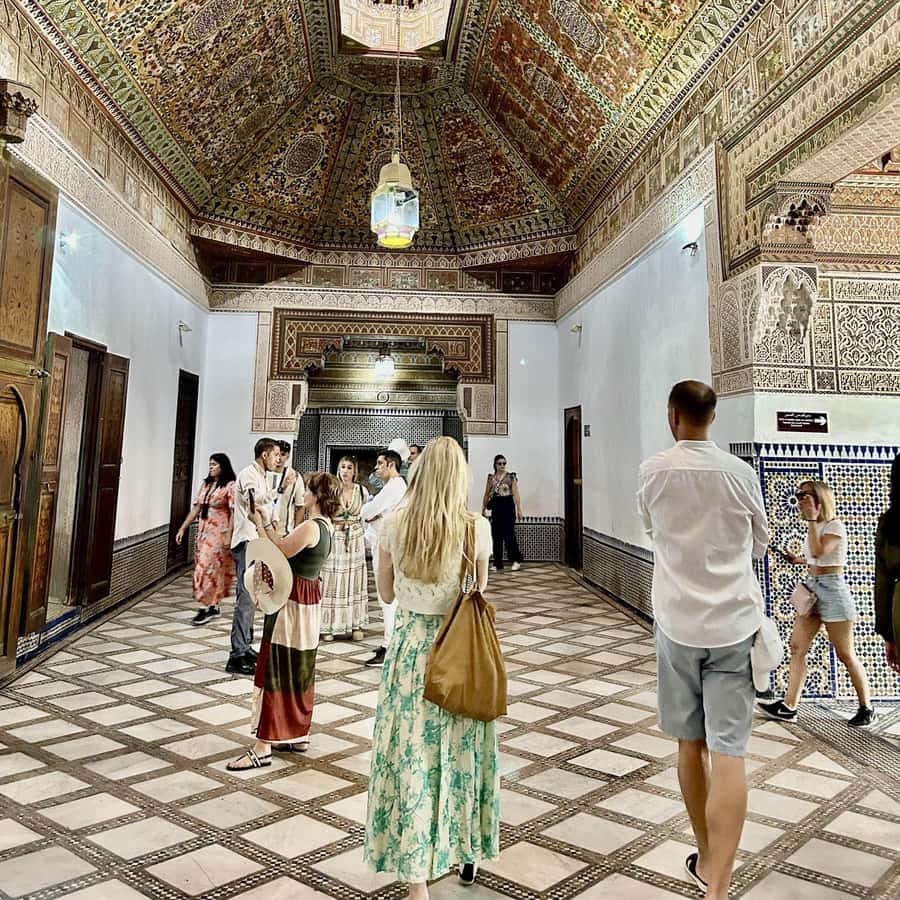
Bahia Palace is one of those Marrakech sights where the guide’s context really helps. You’ll spend about 40 minutes here with a guided visit.
The palace was built in 1894 by Si Moussa, the grand vizier of Sultan Moulay Hassan I. It was intended as a luxurious residence for the grand vizier and his family. And it’s noted as one of the best-preserved historical sites in Marrakech—meaning you’re not just looking at ruins. You’re seeing a place that has kept its character.
Entry is extra: 10€, and again, the tour notes they only accept cash. So it’s smart to line up your cash before you reach this part of the day. If you wait until the last moment, you risk slowing everything down.
This is also a great stop for photos, but I’d spend more time looking than shooting. The value here is in the preservation and the story behind the builder—how political power and household luxury shaped what you can see today.
The Mellah: Jewish Quarter, spice market, and cultural context
Your route then moves into the Mellah, the Jewish Quarter of Marrakech Medina, with about 20 minutes of walking. This area also connects strongly to the spice market, where you can find a wide variety of spices and herbs.
The guide’s job here is important. It’s not only a change of neighborhood—it’s a chance to understand how communities and trade shaped the city. The Mellah is described as having fascinating history and cultural heritage related to Jewish life, and the spice market offers a practical way to connect that history to what you see in the streets now.
A simple way to enjoy this stop: slow down enough to look at the goods, but don’t turn it into a speed-bargain mission. Let the walking pace match the setting. It’s one of the better places on this half-day itinerary to feel the Medina as a lived-in patchwork of cultures and crafts.
Why guides like Ali and Mohammed change the whole experience
This tour works because the guiding style is built around conversation and clarity. The tour description calls out English-speaking guides who are communicative, outgoing, funny, and punctual. And the experiences shared by past customers back that up.
Ali, for example, was praised for being chatty and funny while still being informative. One of the best parts: he gives you time to explore on your own, but stays close enough that you don’t lose the meaning of what you’re seeing. Another highlight from Ali’s style is that the tour doesn’t feel like a cookie-cutter checklist. It’s more like a guided walk with local pacing and attention to what you want to focus on.
Mohammed also stood out for being extremely knowledgeable, with answers that covered history, religion, architecture, and even the education system. That kind of grounding matters in Marrakech, because the city mixes art, faith, markets, and community life in one compact area.
Price and value: what you really pay for at $39
At $39 per person for about 4 hours, this isn’t a “sit on a bus” experience. You’re paying for a private English guide, Medina-area pick-up when possible, and the convenience of skip-the-ticket line.
What’s not included is key:
- Entry fees (Bahia Palace and Ben Youssef have stated costs)
- Food and drinks
- Transportation
If you do both major paid sites mentioned—Bahia Palace (10€) and Medersa Ben Youssef (5€)—you’re adding 15€ in ticket costs on top of the $39. Depending on exchange rates and how you handle meals, your total day spend can still be very reasonable for a guided private walk that covers multiple top Marrakech highlights.
The value is highest if you want guidance that connects the dots: why Jemaa el Fna is the city’s social core, why Ben Youssef’s details matter, and why the Bahia Palace story is more than decoration.
The one risk to keep in mind: no-show happens
There is one serious drawback reflected in customer feedback: one booking reported the guide didn’t show up and communication failed, with the refund taking several days. I can’t sugarcoat that.
How do you protect yourself? Treat meetup timing like a must-do task. Make sure you can be reached on the day of the tour (especially if you rely on an app that might fail). If the tour confirms a meeting point like Café France Gate, show up early enough to get settled.
Most tours run smoothly, but it’s wise to plan for the one bad-case scenario.
Who should book this private Marrakech walk
I think this tour is a strong fit if you want:
- A guided walk through major Medina highlights in half a day
- English explanations that connect sites to how Marrakech works
- A private format where you can ask questions and adjust your pace
It’s also a decent choice for first-timers, because the route covers big icons (Jemaa el Fna, Koutoubia area) plus the more interpretive stops (Ben Youssef Madrasa and Bahia Palace) and then adds the Mellah and market texture.
Less ideal if you:
- Have back problems (the route is not described as gentle)
- Are traveling with very young babies (not suitable for babies under 1 year)
- Use a wheelchair: the notes are conflicting—wheelchair accessibility is listed, but the activity also says it’s not suitable for wheelchair users. If that’s you, I’d contact the provider before booking.
Should you book it?
Book this Marrakech private half-day walk if you want a guided route that mixes the city’s top sights with a real sense of how people live and shop in the Medina. For $39, you’re paying for English guidance, smart pacing, and access convenience like skip-the-ticket line—plus two major culture stops at Ben Youssef and Bahia Palace.
Skip it or reconsider if your budget doesn’t allow extra ticket costs, or if you’re not comfortable handling cash-only entry payments. And if you need extra peace of mind on the day-of coordination, show up early and keep your contact options working.
If you like walking with a local lens—history, faith, markets, and everyday Marrakech—this route is a solid way to spend four hours.
FAQ
How long is the Marrakech private walking guided tour?
It’s about 4 hours long.
What’s included in the price, and what costs extra?
The tour includes an English live guide, and pick-up from a riad/hotel inside the Medina. Entry fees are not included, and food and drinks and transportation are not included.
How much are the entry fees for the main sights?
Bahia Palace is listed as 10€, and Medersa Ben Youssef is listed as 5€.
Do they accept credit cards or cash?
The tour notes that they only accept cash.
Where does the guide meet you?
The guide meets you at the Cafe France Gate. Pick-up is available if your hotel/riad is inside the Medina.
Is it suitable for wheelchair users?
The activity is listed as wheelchair accessible, but it also notes that it is not suitable for wheelchair users. If you rely on a wheelchair, you should clarify before booking.