REVIEW · MARRAKECH
Marrakech walking tour with official city guide
Book on Viator →Operated by Gboo Morocco Tours · Bookable on Viator
Medina chaos, with a guide and a plan. This 4-hour Marrakech walking tour uses an official city guide to help you hit big sights like Bahia Palace, the Saadian Tombs, and Medersa Ben Youssef without wasting time figuring things out. You also get your bearings in the medina area around Jemaa el-Fna with a clear route and a multilingual host.
My two favorite parts: the admission fees are included, so you are not hunting for tickets or second-guessing costs at each stop. And with a maximum of 15 people, the experience stays manageable, especially when you are learning how the medina works. The guide name that stood out for me was Ayoub, and his answers were thoughtful and detailed.
One consideration: this tour requires good weather, and it is still a walking route through streets that can feel crowded and warm. If you hate walking or you have mobility limits, you’ll want to think through your comfort level before booking.
In This Review
- Key highlights worth knowing
- A smart first-day plan for Marrakech’s medina
- Price and value: what $111.50 buys you
- Meeting at Jemaa el-Fna: logistics that reduce stress
- Bahia Palace: more than a pretty palace
- Saadian Tombs: how history stayed hidden, then returned
- Medersa Ben Youssef: a learning place with impressive scale
- Jemaa el-Fna and the souks: orientation plus street-level reality
- Group size, transfers, and why a guide matters here
- What to consider before you book
- Who this tour fits best
- Should you book this Marrakech walking tour?
- FAQ
- What is the duration of the Marrakech walking tour?
- What time does the tour start?
- Where does the tour begin and end?
- Which languages does the official guide speak?
- Are admission fees included for the stops?
- Does the tour include pickup or transfers?
- How large is the group?
- Is the tour focused on walking?
- Are meals and drinks included?
- Is cancellation possible, and how far in advance?
- Is the tour dependent on weather?
Key highlights worth knowing
- Official guide, multilingual support in English, Spanish, and French
- Admission tickets included for Bahia Palace, Saadian Tombs, and Medersa Ben Youssef
- Small group size (max 15) for questions and real guidance
- Pickup offered and round-trip transfers from your hotel
- Smart route timing: three major sites, then a long look at Jemaa el-Fna
A smart first-day plan for Marrakech’s medina
Marrakech can feel like it has two personalities: beautiful monuments and real-life street reality. This tour gives you the best of both. You start with landmark architecture, then you finish where the city’s energy spills into the square and souks.
What I like is the pacing. You are not trying to sprint between “top sights.” You get enough time at each stop—around 30 minutes for the major sites—so you can actually see details, not just pose for photos.
And because it’s led by an official city guide, you get context as you go. That matters in Marrakech, where the same alleyway can lead to very different worlds depending on where you turn.
You can also read our reviews of more walking tours in Marrakech
Price and value: what $111.50 buys you
At $111.50 per person for about 4 hours, this is not a budget-only option. But it does include several value pieces that add up fast in Morocco’s medina.
You are getting:
- A guided route with an English/Spanish/French-speaking official guide
- Fees to enter the listed sites
- A group format that stays small (max 15)
- Pickup offered with round-trip transfers from your hotel
- A mobile ticket, which is usually simpler than juggling paper
The big value lever is the included entry. Buying tickets on your own can be annoying when you’re already navigating crowds, directions, and different ticket desks. Here, the guide handles the flow and you just show up at the right place.
I also notice the booking timing: it tends to get snapped up about 54 days in advance on average. That’s a sign this itinerary hits a sweet spot—popular, efficient, and cover-the-basics without feeling rushed.
Meeting at Jemaa el-Fna: logistics that reduce stress
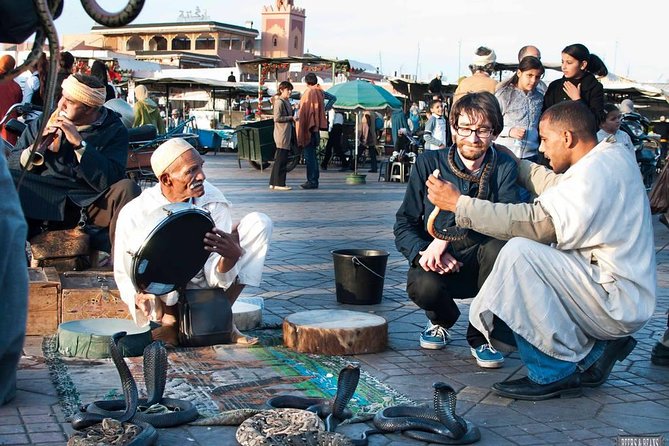
The tour starts at Jemaa el-Fna (Jamaâ El-Fna, Marrakech 40000) at 8:00 am and ends back at the same meeting point. That matters more than it sounds. You avoid ending up far from where you began, and it makes your day-plan easier afterward.
You can also expect pickup offered for round-trip transfers from your hotel. If your riad or hotel is in the medina, that can be the difference between an easy start and a complicated taxi-and-walk situation.
The day runs about 4 hours total, and the itinerary layout is very straightforward:
- Bahia Palace
- Saadian Tombs
- Medersa Ben Youssef
- Jemaa el-Fna area (plus time for the souks atmosphere)
One more practical note: the tour is marked as requiring good weather. If you are traveling in a period with unstable weather, keep an eye on forecasts and be ready for a date change or refund if the operator cancels due to conditions.
Bahia Palace: more than a pretty palace
Bahia Palace is the kind of place where you look once and then want to look again. It is a 19th-century palace built in the medina area, and it became one of Morocco’s major heritage monuments. The scale is real: the palace sits across about eight hectares, and the palace area noted here includes a northern section of about 8,000 m².
You will visit a section that tells a specific story. Between 1866 and 1867, the palace’s northern part was built close to the current royal palace by architect El Mekki for Si Moussa, chamberlain of Sultan Hassan I.
Why this stop works in a walking tour: the guide can help you spot what makes the palace “masterpiece” level. Without that, it is easy to get stuck in photo-mode and miss the architectural logic. With the guidance, you’re more likely to notice patterns, layout, and why the place feels grand even by Moroccan palace standards.
Time-wise, you’re there for about 30 minutes and the entry ticket is included. That duration is long enough to see the highlights and short enough that you do not feel stuck waiting through a slow pace.
A mild caution: palaces can be visually overwhelming. If you are the type who needs one theme to focus on, ask your guide a question at the entrance, like what the key rooms or design features are to watch for during your visit.
Saadian Tombs: how history stayed hidden, then returned
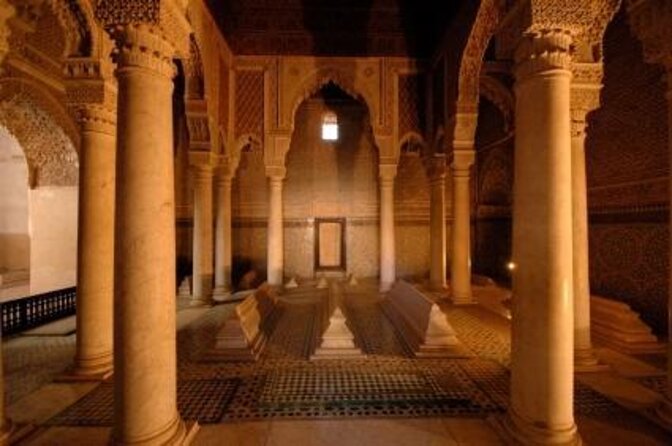
Next up are the Saadian Tombs, located next to the Kasbah Mosque. These are among the few surviving traces of the Saadian dynasty, which reigned during Marrakech’s golden age (1524 to 1659).
Here’s the story that makes this stop click: early 18th century, Sultan Moulay Ismail ordered the destruction of remaining vestiges of that dynasty. He didn’t commit the sacrilege of destroying the burials, but he completed the entrance to the necropolis. The secret stayed hidden until 1917, when the site was rediscovered.
That blend—power politics, careful preservation, and a “found again” moment—gives you more than a pretty cemetery. It turns the visit into a historical puzzle you can actually understand in real time.
You’re at the Saadian Tombs for about 30 minutes, with the entrance fee included. That’s usually the right length here. The space holds interest, but it does not require an all-day commitment.
One practical consideration: the area is close to a mosque, so expect an environment that is active and respectful. Keep your voice down, move with care, and follow your guide’s cues.
You can also read our reviews of more guided tours in Marrakech

Medersa Ben Youssef: a learning place with impressive scale
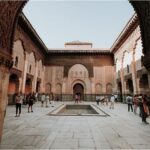
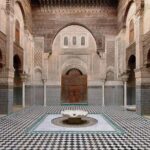
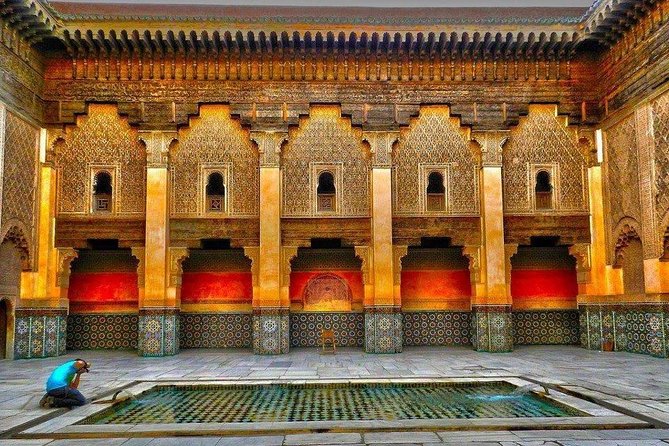
Medersa Ben Youssef is a Koranic school, and it feels like walking into education architecture. It was founded in the early 14th century by Abu el Hassan. Later, during the Saadian period, it was enlarged and redecorated in 1570, and it became the largest Islamic college in the Maghreb region.
The numbers help you picture the scale: up to 900 students could live there to study law and theology. The monastery-like support system mattered, too—food and lodging were supported, but the kitchen work was something students handled themselves.
In 1960, it was transformed into a museum, and after renovations in 1999, it became one of the most popular sites in Marrakech. One detail I’d watch for: the bronze doorway at the entrance of the college. Your guide can point out what to look at so you do not just walk past it.
You’re again working with about 30 minutes plus included entry. This stop is ideal for people who like cultural sites that are also visually specific. If you enjoy learning how a place was designed for study and daily life, this is often the strongest “wow” moment of the route.
Jemaa el-Fna and the souks: orientation plus street-level reality
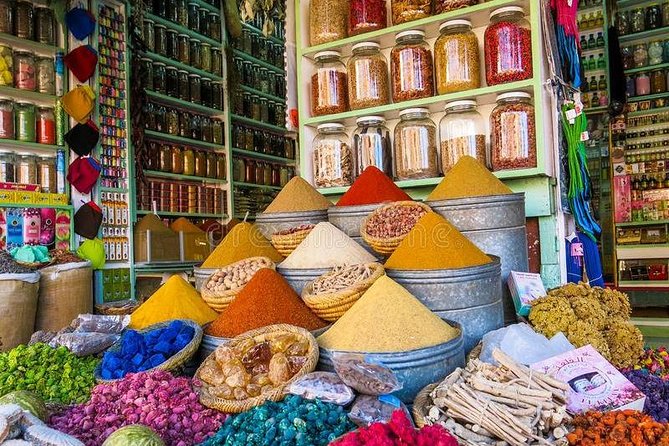
You finish back at Jemaa el-Fna, with about 1 hour to take in the square and surrounding souks. This part can feel chaotic at first—crowds, noises, smells, and people trying to catch your attention. But a guide helps you turn that chaos into understanding.
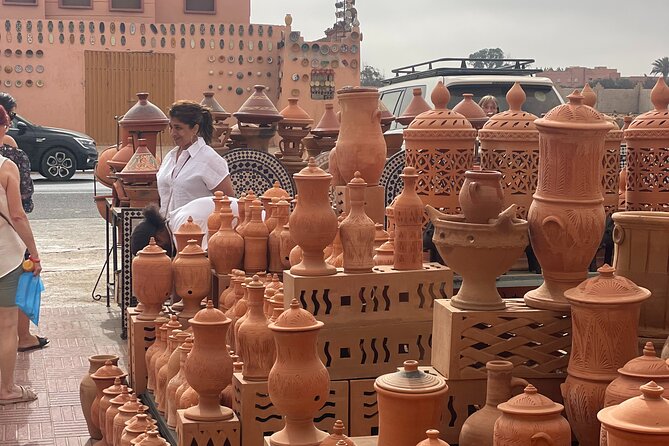
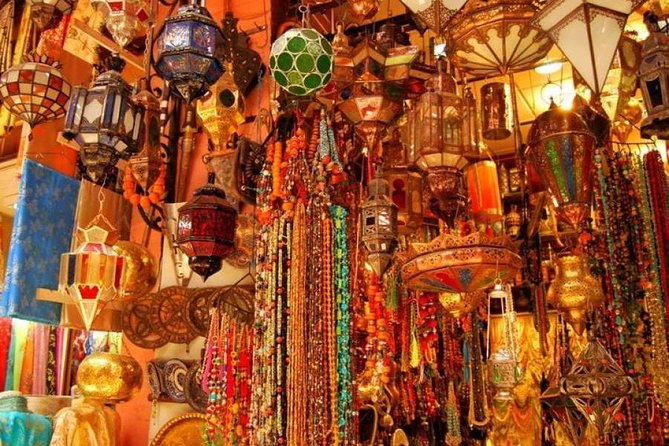
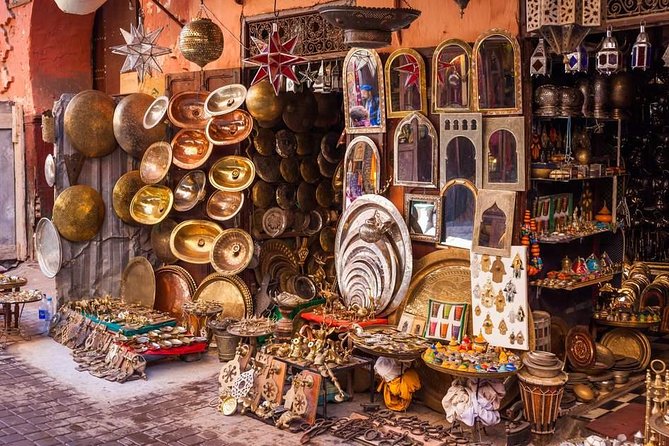
The guide context you get here is useful: Marrakech’s souks are open-air markets tied to trading routes from north, south, east, and west. Goods moved through these routes to Marrakech, including from surrounding African countries and farther afield. That’s why the square matters: it sits at the center of old commerce networks.
You’ll also get a grounded explanation of what a souk is—an Arab market, traditionally where locals relied on essentials. It is not only a tourist experience. It is still part of how everyday life functions in Marrakech.
Why the timing works: after three heritage stops, you switch gears. You go from palace and school architecture into the living marketplace that gives Marrakech its texture. It is also where you can ask practical questions, like which streets to avoid if you want calm, or how to handle bargaining without getting pulled too far off course.
Group size, transfers, and why a guide matters here
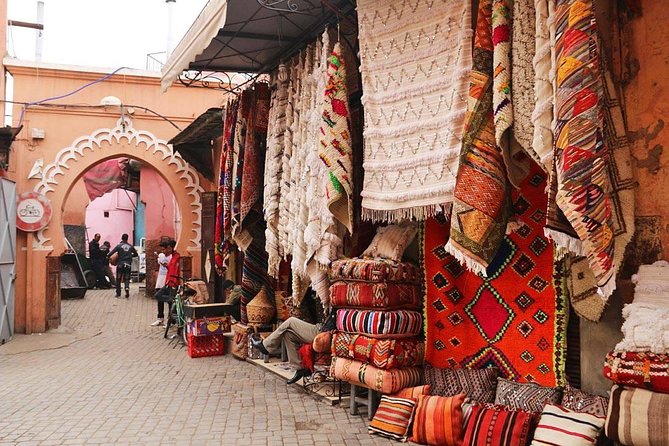
This tour caps at 15 travelers, and that is a big deal in Marrakech. Smaller groups mean your guide can keep you together without treating you like a line of luggage.
Multilingual help (English, Spanish, French) is also a practical advantage. You can ask questions in the language you’re comfortable with, which makes the site stories land better.
And yes, the guide personality matters. In one experience on this route, the guide Ayoub was described as thoughtful and attentive, answering questions in detail. Even if your guide is different, the job is the same: make the medina make sense, not just “show you sights.”
If you want to get the most out of your hour at the square, ask your guide one direct question early. For example, ask what to look for in the souks as a first-time visitor, or what the safe and easy shopping lanes are if you just want to browse.
What to consider before you book
This tour is a walking itinerary. Even with included transfers and a guided route, you’ll still be moving through streets and standing in lines at sites. If you have a heat sensitivity problem or stamina limits, consider whether the 8:00 am start helps enough for you.
Also, the tour requires good weather. If conditions are poor, the operator may cancel and offer another date or a refund.
Finally, meals and drinks are not included. Plan to eat before or after, not during. Bring water, especially for the Jemaa el-Fna portion.
Who this tour fits best
I think this tour is a great match for:
- First-time Marrakech visitors who want a structured intro
- People who want entry fees handled
- Travelers who like small group pacing (max 15)
- Anyone who prefers learning from an official guide rather than self-guiding through the medina maze
If you already know Marrakech well, or if you want long, slow wandering with lots of flexible time, you might find the fixed 4-hour structure limiting.
Should you book this Marrakech walking tour?
Yes—if you want an efficient, guided hit of Marrakech’s major sights without ticket headaches. The included admissions and official, multilingual guide reduce friction right when Marrakech’s medina can overwhelm first-timers.
I’d especially book it if you value structure: Bahia Palace, Saadian Tombs, Medersa Ben Youssef, then Jemaa el-Fna is a logical learning arc. You move from power and architecture to buried dynastic history to a school shaped for education, ending in the square where the city’s trading heartbeat is still visible.
Skip it (or think hard) only if walking is a problem for you or if you’re in a period where weather uncertainty is likely. Otherwise, this is a solid value way to see key highlights in one morning.
FAQ
What is the duration of the Marrakech walking tour?
The tour lasts about 4 hours.
What time does the tour start?
The start time is 8:00 am.
Where does the tour begin and end?
It begins at Jemaa el-Fna in Marrakech and ends back at the meeting point.
Which languages does the official guide speak?
The guide speaks English, Spanish, and French.
Are admission fees included for the stops?
Yes. Fees to enter the sites are included.
Does the tour include pickup or transfers?
Pickup is offered, and the tour includes round-trip transfers from your hotel.
How large is the group?
The tour has a maximum of 15 travelers.
Is the tour focused on walking?
Yes. It is a walking tour with time at each stop in the itinerary.
Are meals and drinks included?
No. Meals and drinks are not included.
Is cancellation possible, and how far in advance?
Free cancellation is available up to 24 hours in advance for a full refund.
Is the tour dependent on weather?
Yes. It requires good weather, and if it is canceled due to poor weather, you’ll be offered a different date or a full refund.