REVIEW · MARRAKECH
Marrakech madina, Bahia Palace & Ben Youssef madrsa
Book on Viator →Operated by Morocco Sunny Days · Bookable on Viator
Medina magic starts right at Jemaa el-Fnaa. This 4-hour guided walk threads through Marrakesh’s historic center, from the Jewish quarter and spice-souk lanes to major landmarks, with a friendly, certified guide named Yassine. It’s an efficient way to understand what you’re looking at, and where you’ll want to return later.
I especially love the “first-trip orientation” feeling. You’ll get a sense of the Bahia Palace vibe and why its rooms, mosaics, and painted details mattered, then you’ll shift to the Ben Youssef medersa and start spotting the craftsmanship right away. A quick craft workshop stop also helps you see how artisans make leather goods, metalwork, and textiles in the same day.
One thing to consider: entry tickets for the big indoor sights (Bahia Palace and Ben Youssef) aren’t included, so you’ll want to budget a little extra on the day and move at a walking-pace through the medina’s lanes. Also, the tour notes good weather is important since this is largely outdoors.
In This Review
- Key highlights you’ll actually feel on the ground
- Getting oriented in Marrakech’s medina, without getting lost
- Jemaa el-Fnaa: UNESCO drama, market energy, and the perfect starting point
- The Jewish-quarter start and the spice-souk wayfinding lesson
- Bahia Palace: stucco, mosaics, and why the gardens matter
- Ben Youssef medersa: zellij tiling and stucco you can actually spot
- Atelier Craft Marrakech stop: a short taste of real artisan work
- Koutoubia Mosque: the 12th-century symbol you can’t really miss
- Price and logistics: what $15.85 buys you (and what it doesn’t)
- Who should book this tour, and who might prefer something else
- Should you book this Marrakech medina walk?
- FAQ
- How long does the Marrakech medina tour take?
- What is included in the price?
- Are entry tickets to Bahia Palace and Medersa Ben Youssef included?
- Where does the tour start and end?
- What’s the maximum group size?
- Are service animals allowed?
- What happens if the tour is canceled due to poor weather?
- Can I cancel for a full refund?
Key highlights you’ll actually feel on the ground
- Small group limit (up to 15) keeps the walk manageable in narrow lanes
- A route that teaches your bearings fast so you’re not guessing later
- Bahia Palace rooms plus garden time for standout stucco, mosaics, and painted detail
- Ben Youssef medersa design focus with zellij tiling, stucco, and wood carvings
- Souk and spice-market experience where you can look for traditional artisan goods
- Koutoubia Mosque stop to see a 12th-century icon and its famous minaret
Getting oriented in Marrakech’s medina, without getting lost
Marrakech’s medina can be wonderfully intense. The lanes twist, the sounds stack on top of each other, and it’s easy to feel like you’re moving but not learning. This tour is built for that exact problem. You start at Café de France (72 Rue des Banques) and then your guide helps you connect the dots between neighborhoods, markets, and monuments.
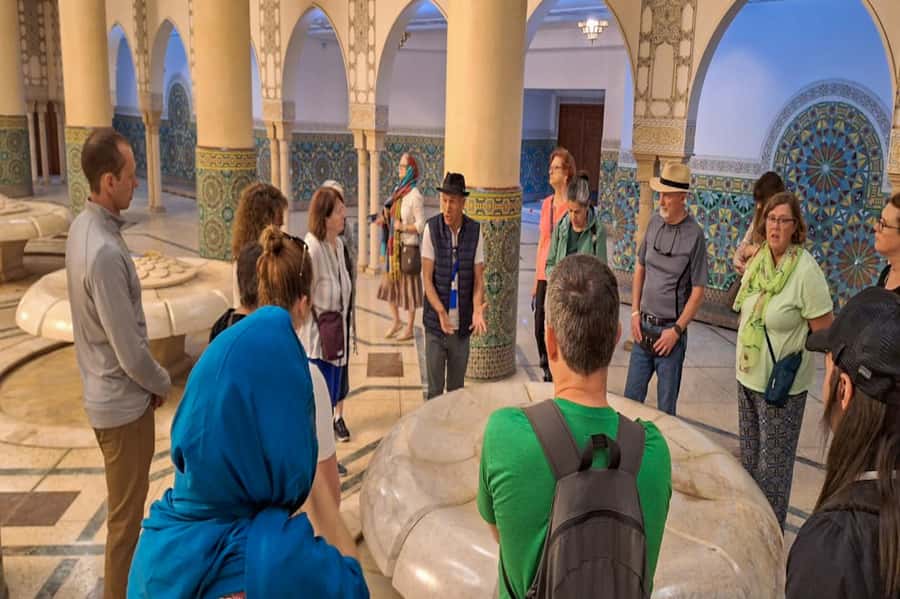
The group size matters here. With a maximum of 15 people, you won’t have that awful, stretched-out line where nobody can hear the guide. You also get practical advice on what to prioritize once you’re out on your own. I like that the tour isn’t only “look, look, look.” You get free time to explore the monuments, so you can slow down when something grabs your attention.
One small but real plus: the route mixes outdoor highlights with indoor craftsmanship stops. That keeps the experience from turning into one long walking sprint. And it makes the palace and medersa sections feel more earned.
You can also read our reviews of more tours and experiences in Marrakech.



Jemaa el-Fnaa: UNESCO drama, market energy, and the perfect starting point
You’ll begin at Jemaa el-Fnaa, Marrakech’s famous square. It’s UNESCO-recognized, and you can feel why quickly. Even in the daytime, the space has a stage-like quality: storytellers, food smells, people-watching, and that constant sense that something is about to happen.
You’ll spend about 20 minutes here. That’s not enough to exhaust the square, but it’s plenty to set your mental map. The key value is timing and contrast. If your walk happens to overlap with evening market energy, the square shifts in a very noticeable way—more momentum, more lights, more food activity. Even if you don’t catch the peak night feel, you’ll still understand why people call this the heart of Marrakech.
A practical tip: as soon as you leave the square, watch how people move. The medina is not a grid. It’s a set of lanes that funnel you. Your guide’s presence helps you learn where the main pull points are—so later, when you return for dinner or shopping, you’ll feel less like you’re guessing.
The Jewish-quarter start and the spice-souk wayfinding lesson
Right after Jemaa el-Fnaa, you’ll head into the medina with a first stop tied to the area’s Jewish heritage. The exact background details you’ll hear can vary depending on how your guide frames it, but the big point is the same: you’re not just touring buildings. You’re walking through layers of Marrakesh’s political, economic, and cultural life.
Then comes a key part of the experience that I think many visitors underestimate—the market logic. You’ll move through the area known for spices and shop lanes where traditional artisan products show up in a big, chaotic range. It’s not only a shopping stop. It’s a lesson in how the medina’s trade works: what people sell, how goods are displayed, and how bargaining and browsing fit together.
This matters because the souk can feel overwhelming if you hit it cold. With a guide, you learn what you’re looking at before you start spending time comparing prices or quality. I also like that the day doesn’t pretend shopping is an afterthought. Souks are part of the culture here.
Bahia Palace: stucco, mosaics, and why the gardens matter
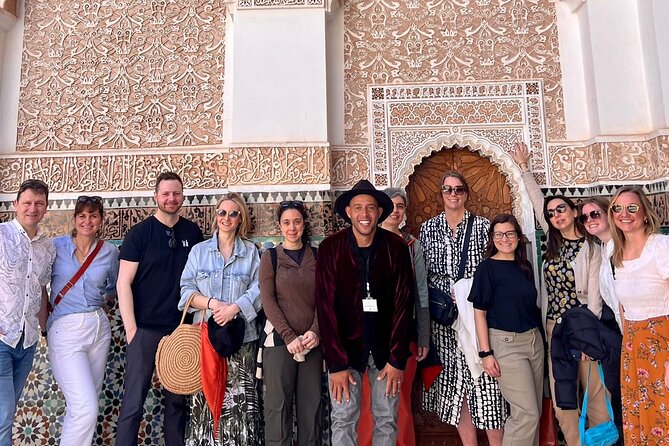
After the market navigation, the pace shifts at Bahia Palace. This is a 19th-century complex, and the focus is decoration. You’ll see rooms with stunning stucco work, paintings, and mosaics, plus a set of gardens that give you a needed visual break from the medina’s intensity.
You’ll have about an hour here, and that time allotment is the sweet spot for a palace like this. More time can be tiring because the detail can stack up. Less time and you miss the “aha” moments—like noticing how materials and patterns guide your eye, or how the palace’s layout creates pauses.
One drawback: entry tickets to Bahia Palace aren’t included. That’s not a dealbreaker, but it means you should plan for ticket cost on the day. Your guide also mentions advice and free time, which helps. You’ll want to use that free time to sit for a minute in the garden areas, if only to reset. It’s one of those places where a short rest improves how much you enjoy the craftsmanship.
If you’re the kind of traveler who likes to look beyond walls and into design details, Bahia Palace is one of the better uses of a half day in Marrakech.
Ben Youssef medersa: zellij tiling and stucco you can actually spot
Next comes Medersa Ben Youssef, one of the best-known Islamic colleges in North Africa. The site was closed in 1960, then refurbished and reopened to the public in 1982. Even with a relatively short visit (around 30 minutes), the place lands because the decoration is so distinctive.
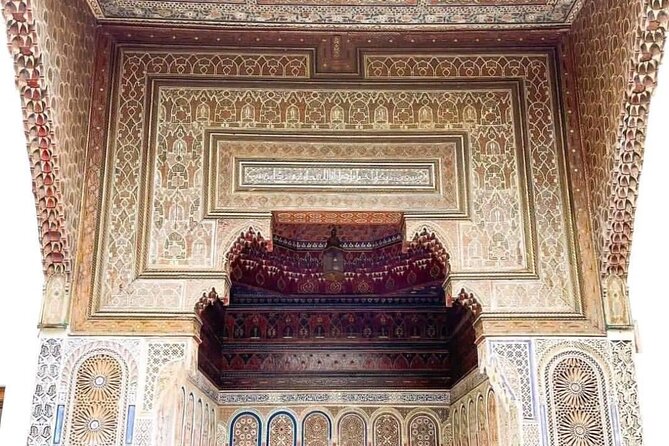
Here’s what you’ll notice when you’re there: zellij tiling, incredible stucco work, and beautiful wood carvings. This is the kind of building where the “wow” isn’t only one big view. It’s lots of smaller details—patterns, texture, craftsmanship lines—that reward close looking.
Thirty minutes is not a marathon, so the smart move is to prioritize. Look at the most decorative areas first, then come back for a second glance if you can. Your guide’s explanations help you understand what you’re seeing, so you’re not just collecting pretty photos. You’re learning why the design is laid out the way it is.
Just like Bahia Palace, entry tickets aren’t included. Plan for that, and you’ll keep the day feeling smooth instead of rushed at the ticket counter.


Atelier Craft Marrakech stop: a short taste of real artisan work
You’ll also stop briefly at a traditional handicraft workshop experience at Atelier Craft Marrakech. This is short—about 5 minutes—but it’s a useful palate cleanser. The goal is to show you how artisans practice age-old techniques and how those techniques translate into products you can recognize later in the souk.
You may see artisans working on things like leather goods, intricate metalwork, and vibrant textiles. In a short stop like this, I treat it like a “pattern recognition session.” You’re learning how quality looks and feels, so when you’re shopping on your own, you know what to ask about and what to compare.
This is also where expectations help. If you want a long workshop class, this probably won’t satisfy that. If you want a guided, quick introduction to crafts so you can shop with your eyes open, it’s a good fit.
Koutoubia Mosque: the 12th-century symbol you can’t really miss
To close out the major landmarks, you’ll reach Koutoubia Mosque. The minaret is described as the highest structure in Marrakech, and the largest mosque in the city. It’s also built in the 12th century, which gives the stop extra weight.
You’ll spend about 10 minutes. That’s enough time to see the scale and understand why locals treat this as a symbol. It also works well near the end of the walk because you’ve already absorbed enough palace-and-medersa detail for your eyes. Here, the value is the landmark clarity.
The best way to enjoy this stop is not to over-plan it. Take it as a “finish line” moment: you’ve walked the medina’s history lanes, you’ve seen decorative interiors, and now you land on an outdoor icon that anchors the city.
Price and logistics: what $15.85 buys you (and what it doesn’t)

At about $15.85 per person, this is a strong-value option if you’re a first-time Marrakech visitor or if you only have a half day for major sights. The price covers a certified guide, a walking tour, advice, and free time to explore monuments.
What it doesn’t include is monument entry. Bahia Palace and Medersa Ben Youssef require tickets, and tipping isn’t included either. That’s typical for guided city walks, but it’s important for budgeting. Still, when you compare what you get—major cultural stops plus guidance through the souk logic—the guided part feels worth it.
Also note the tour uses a mobile ticket, and confirmation is received at booking. It’s generally booked about 15 days in advance on average, which suggests it’s popular for good reason.
If you prefer to self-tour everything, you could do that. But if you want to learn your way around, understand what you’re seeing, and avoid spending hours in the wrong alleys, the guide time is the real value.
Who should book this tour, and who might prefer something else
This experience fits best if you:
- Want to get bearings fast in the medina
- Like history told through the streets, not just through museum panels
- Enjoy craftsmanship details, especially on tiles, stucco, and woodwork
- Want a manageable walking schedule with a small group (up to 15)
It’s also a good pick early in your trip. Starting with a route like this helps you navigate later, especially if you plan to return for shopping or longer museum visits.
You might choose a different format if you:
- Want long, seated time inside monuments (this tour moves with defined time windows)
- Don’t want to handle separate ticket purchases on the day
- Are traveling strictly for shopping only (the souk and craft angles are real, but this is still a heritage-focused walk)
Should you book this Marrakech medina walk?
Yes—if you want an efficient, guided way to connect Marrakech’s big cultural sights with the lived-in reality of the medina. The mix works: Jemaa el-Fnaa sets the atmosphere, Bahia Palace and Ben Youssef show you high-skill craftsmanship, and the short craft-souk stops help you shop with better instincts afterward. With Yassine leading and a group size that stays small, it’s one of those tours that makes your next day easier, not just your half day busier.
Book it early in your trip, wear comfortable shoes, and bring a little extra for monument tickets. If weather looks shaky, plan your flexibility too, since the tour depends on good conditions for walking.
FAQ
How long does the Marrakech medina tour take?
The tour lasts about 4 hours.
What is included in the price?
The price includes a certificated tour guide, advice, a walking tour, and free time to explore monuments. It also includes a short craft workshop stop.
Are entry tickets to Bahia Palace and Medersa Ben Youssef included?
No. Entry tickets to those monuments are not included, so you’ll need to purchase them separately.
Where does the tour start and end?
The tour starts at Café de France, 72 Rue des Banques, Marrakech 40000, Morocco, and it ends back at the same meeting point.
What’s the maximum group size?
The tour has a maximum of 15 travelers.
Are service animals allowed?
Yes, service animals are allowed.
What happens if the tour is canceled due to poor weather?
If it’s canceled due to poor weather, you’ll be offered a different date or a full refund.
Can I cancel for a full refund?
Yes. You can cancel up to 24 hours in advance for a full refund. If you cancel less than 24 hours before the start time, the payment is not refunded.