REVIEW · MARRAKECH
Guided Marrakech City Tour
Book on Viator →Operated by Maaffar travel agency Morocco · Bookable on Viator
Marrakech makes sense faster with a guide. I like the stop-to-stop focus on major sights like Medersa Ben Youssef and the palaces, plus the way guides like Maaffar and Houcine explain what you’re seeing without turning it into a lecture. One thing to plan for: most major entrances cost extra (and lunch/tea are on you).
This tour is built for getting your bearings. You start at 9:00 am, ride in an air-conditioned vehicle between key areas, and then walk through parts of the medina where the streets can feel like a puzzle box. The group is capped at 25 travelers, so you’re not lost in a crowd.
With a mix of grand monuments (Bahia Palace, El Badi, Saadian Tombs) and daily-life stops (Mellah markets, Rahba Kedima, Jemaa el-Fnaa), you’ll come away with both architecture and atmosphere. Just bring sturdy shoes and a little patience for pauses, bargaining, and the occasional slow-moving alley.
In This Review
- Key highlights to look for
- Starting at 9:00 am: why the timing matters in Marrakech
- Medersa Ben Youssef: the tilework learning palace (plus a real entry fee)
- Mellah and the Slat Al Azama Synagogue: a different side of the medina
- Bahia Palace: 150 rooms, a harem section, and a big Court of Honour
- El Badi Palace: Saadian ambition, Portugal revenge, and a 70-dirham ticket
- Rahba Kedima Square and Jemaa el-Fnaa: markets and a culture you can see without paying
- Saadian Tombs: from forgotten graves to a restored landmark
- Group tour reality: what you get with Maaffar and Houcine-style guiding
- Price and what it really costs: $40.67 plus tickets
- Practical tips for a smoother Marrakech day
- Should you book this Marrakech city tour?
- FAQ
- What is the duration of the Marrakech city tour?
- What time does the tour start?
- Is pickup included?
- Does the tour price include admission tickets?
- How much extra should I budget for entrance fees?
- What is the cancellation policy?
Key highlights to look for
- Medersa Ben Youssef’s Zellige tilework and its legacy as a major learning center
- A Mellah walk that includes Slat Al Azama Synagogue plus a look at Jewish life and the cemetery
- Bahia Palace with its 150 rooms and the big, dramatic Court of Honour
- El Badi Palace and its Saadian-era design, plus a garden you can actually enjoy
- Markets without ticket pressure at Rahba Kedima and the square at Jemaa el-Fnaa
Starting at 9:00 am: why the timing matters in Marrakech
Marrakech is best when you see it before the day gets heavy. This tour kicks off at 9:00 am, which helps you tackle the medina sights while streets are still manageable and light is nicer for photos. You’re also not spending half your vacation figuring out which door to enter or which direction to go next.
The structure is practical: guided sightseeing plus transport. The tour includes an air-conditioned vehicle, so you’re not stuck doing every transfer on foot. That matters because Marrakech stretches out, and waiting for a taxi when you’re sweaty and distracted is how good plans turn into cranky ones.
Expect a day that runs about 7 hours total, with a break built in for café time or Moroccan tea. That pause is more than a nice-to-have. It gives you a reset before you head back into market lanes and palaces where your legs and attention both take a hit.
Finally, keep the group size in mind. With a maximum of 25, it should stay organized, and your guide can still keep an eye on the whole group when the medina gets tight.
You can also read our reviews of more guided tours in Marrakech

Medersa Ben Youssef: the tilework learning palace (plus a real entry fee)
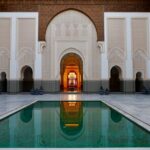
The Medersa Ben Youssef is where you start to understand why Marrakech feels so artistic. This was a major center for study in the 1500s—founded between 1564 and 1565 by Sultan Abdullah Al-Ghaleb Assaadi—and it drew scholars and students across subjects like religious studies, philosophy, medicine, and mathematics. Even if you’re not a history person, the place makes you slow down.
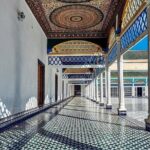
The big visual hit is the Zellige: those intricate geometric and floral ceramic patterns that cover surfaces with serious attention to detail. You’ll walk through enough of it to get the feeling, but the guide’s job is to point out what you might otherwise miss—like how the architecture supports the medersa’s learning purpose.
Practical note: the entry fee here is 50 dirhams per person (so it’s not included in the tour price). That’s not a deal-breaker, but it does mean you should budget for several sites on this route.
One small consideration: medersa visits can feel strict compared with outdoor spaces. You’ll likely be moving indoors with other visitors, so bring a calm pace—think museum mode, not street mode.
Mellah and the Slat Al Azama Synagogue: a different side of the medina
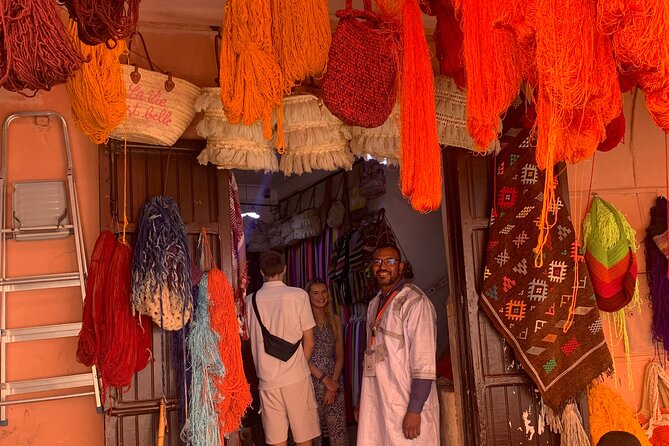
After the medersa, you shift into the Mellah area, Marrakech’s historic neighborhood associated with the city’s Jewish community. Your stop includes the Slat Al Azama Synagogue (often noted as Lazama Synagogue), where you can admire the tiled courtyard and visit exhibits focused on Jewish life.
This stop is valuable because it adds texture. Marrakech is famous for Islamic architecture and palaces, yes. But the Mellah layers in stories you’d miss if you only chase the most obvious postcard spots. You’ll also be guided through the surrounding context: the Mellah Market area with fresh meat and produce, plus nearby lanes like the Bab Mellah Spice Souk.
There’s also the Miaara Jewish cemetery nearby, which is part of why this whole neighborhood matters. It turns a short visit into something more reflective, even in a lively market district.
Important practical point: the tour states that admission for this stop isn’t included. The exact amount isn’t listed for you here, so treat this as a variable cost and keep a little extra dirham in your pocket.
If you get the urge to shop right after this stop, that’s normal. Your guide can help you pace it so you don’t burn energy too early—or get pulled into long conversations before you see Bahia and El Badi.
Bahia Palace: 150 rooms, a harem section, and a big Court of Honour
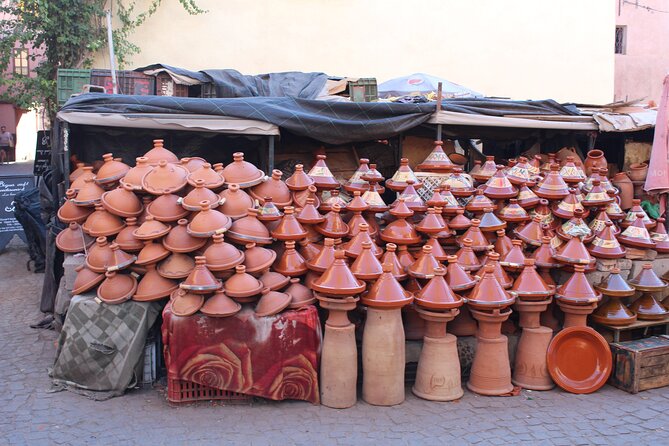
Then comes Bahia Palace, and it’s the kind of sight that makes your brain go, Wait, where am I supposed to look first? Built in 1866–1867 by Si Moussa, the palace was designed to project power and refinement, and it covers 150 rooms, including a harem section that opens to the Court of Honour.
What I like about Bahia is that it’s both readable and dramatic. You can follow the flow of spaces even if you don’t know the dynasty. The Court of Honour gives you a clear focal point, and from there the guide can explain who lived here and how the palace’s role changed over time.
During the French Protectorate, Bahia Palace served as the residence of the Resident General. Later, Si Moussa’s son, Bou Ahmed, ruled from 1894 to 1900, and the palace’s story develops with him.
Entry fee here is listed at 100 dirhams, which is the highest listed ticket price in the set. Still, it can be worth it because Bahia is one of those places where the scale feels real, not just decorative. You’re paying for rooms, details, and a sense of how these spaces were actually arranged.
One drawback to keep in mind: 150 rooms means your feet do the talking. Wear shoes you can walk in for a while.
El Badi Palace: Saadian ambition, Portugal revenge, and a 70-dirham ticket
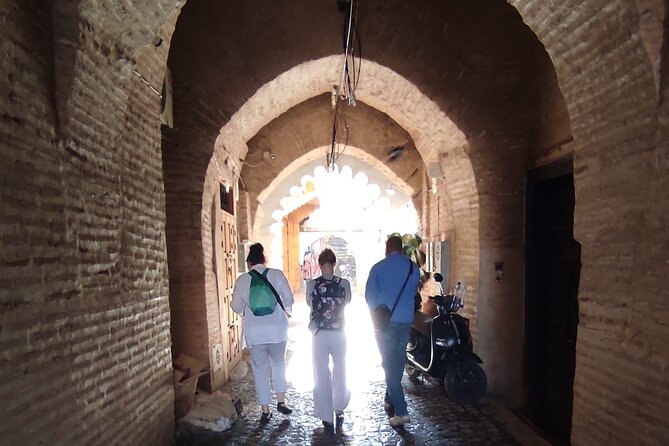
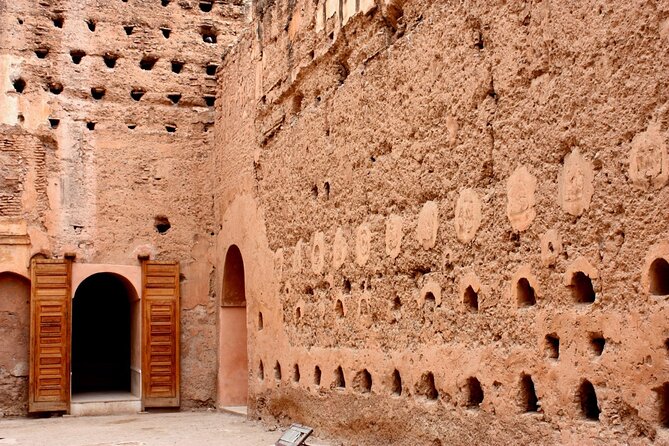
El Badi Palace is pure big-era power display. It was built in the late 16th century by Saadian Sultan Ahmed al-Mansur to commemorate triumph over Portugal after a famous battle. The project took a stated 25 years and a large workforce to finish, so the result wasn’t meant to be modest.
Inside the palace complex, you’re looking at a 360-room site known for decorative finishes—think gold, turquoise, and crystal-style details. Add the palace gardens, and you get a mix of monument and pause spaces, which helps when your day is already packed.
This is also a place where a guide can really matter. Without context, you might just see walls and ruins. With context, you understand it as a statement: Saadian dynasty branding in stone and plaster.
Entry fee is listed at 70 dirhams, again not included in the tour price. Plan for it, and don’t try to squeeze El Badi in if you’re already exhausted. This stop asks for attention, even when the site is partly in ruins.
If you’re the type who loves stories of city politics—who built what, and why—El Badi will feel extra satisfying.
You can also read our reviews of more city tours in Marrakech


Rahba Kedima Square and Jemaa el-Fnaa: markets and a culture you can see without paying
After the heavyweights of palaces, you get a lighter, more everyday rhythm at Rahba Kedima Square and then Jemaa el-Fnaa.
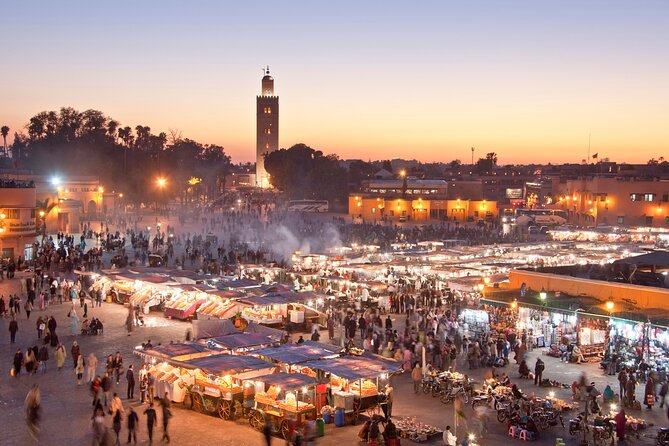
Rahba Kedima is tied to market tradition in the medina. Souk Laghzal is described as connected to women who sewed traditional clothes and crafted local hats. There’s also Rahba Lakdima, now popular for spices and herbs, plus it acts as a main market for carpets. The stop is public-market style, and entry is free.
Then there’s Jemaa el-Fnaa, the famous square that’s been a city cornerstone since the 11th century. This isn’t about ticketed attractions. It’s about performance and everyday culture: music, spiritual rituals, and artistic street life. The square’s meaning is bigger than any single photo—your guide can help you read what you’re seeing.
Practical caution: when a place is free, it also attracts more pressure—extra attention from sellers and onlookers. It’s not dangerous, but it can be tiring. The tour includes walking time here, so if you hate feeling “on display,” ask your guide for a strategy early.
Both of these stops are great because you can spend time looking without adding another admission line to your budget.
Saadian Tombs: from forgotten graves to a restored landmark
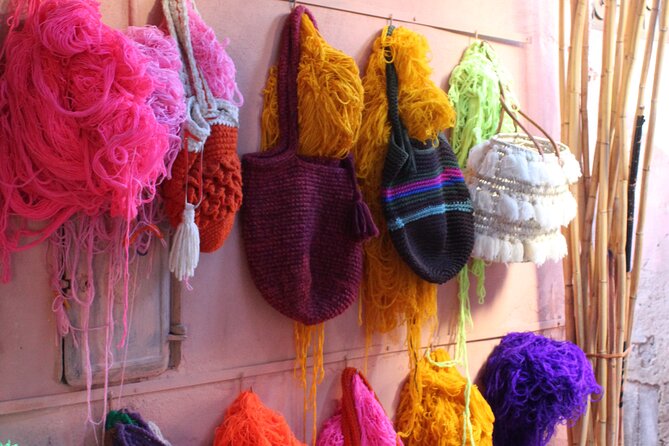
The Saadian Tombs are one of those Marrakech stories that has a built-in plot twist. They were built during Sultan Ahmad al-Mansour’s reign (1578–1603) and were later forgotten until rediscovery in 1917. After restoration, they became a major site again—one where you can see not only the graves but the artistry of the era.
The tombs house remains of sixty Saadians, including al-Mansour. One standout space is the room of twelve columns, tied to the Sultan’s tomb, featuring a carved cedar dome and intricate stucco designs. The graves are made using Italian Carrara marble, which gives the site a particular weight and contrast.
Entry fee here is listed at 70 dirhams, again not included in your tour price. This is one of those stops where you’ll be glad you didn’t skip it. It gives you a different side of Marrakech than palaces: more quiet, more personal, more about legacy.
This is a good place to slow down. The best way to enjoy it is to stand still longer than you think you should, and let the guide point out the details.
Group tour reality: what you get with Maaffar and Houcine-style guiding
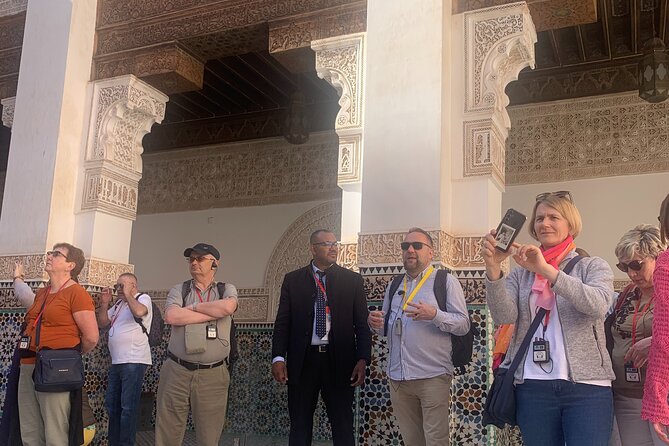
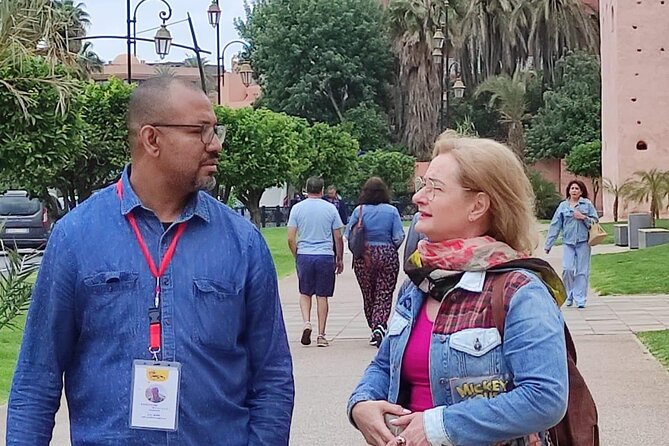
A big chunk of your enjoyment here is the human part. The guides tied to this operation—names like Maaffar and Houcine—show up in the feedback for being organized, polite, and patient, and for sharing useful context about both history and present-day life in Marrakech.
You’ll also get practical shopping advice. One repeated theme is guidance on how to handle sales pressure in the souks. That matters because Marrakech markets can feel like a test. A good guide doesn’t just say where to go; they help you manage the conversations so you can shop without losing your cool or your time.
Another plus: people specifically mention walking to less obvious spots and using the guide’s stories to make the city feel connected. That’s why a guided tour is worth it here, even when you could technically wander on your own. In the medina, getting lost costs more than time. It costs your confidence.
Potential drawback: with a group setting and a capped size, you’ll still move on someone else’s timetable. If you’re the type who wants to linger for long photo sessions at every tile pattern, you might feel a bit rushed at the most popular indoor sites.
Price and what it really costs: $40.67 plus tickets
The headline price is $40.67 per person, and that’s fair when you remember what’s included: a guide and an air-conditioned vehicle.
The catch is that site admissions are not included. Here are the clearly listed tickets:
- Medersa Ben Youssef: 50 dirhams
- Bahia Palace: 100 dirhams
- El Badi Palace: 70 dirhams
- Saadian Tombs: 70 dirhams
- Rahba Kedima Square: free
- Jemaa el-Fnaa: free
- Slat Al Azama Synagogue: not included (specific price not listed)
So your total spend depends on your ticket mix and any entry cost at the synagogue stop. You also pay for lunch, and coffee/tea is not included, even though there is time for a break.
My advice: treat the tour price as the transportation + guidance portion, and treat monuments as the add-on costs. If you budget for the listed tickets plus a meal, you won’t feel surprised when you’re standing at a ticket counter.
Practical tips for a smoother Marrakech day
This route mixes indoor monuments with outdoor streets, so a few basics really help.
Wear shoes that can handle walking on uneven medina surfaces. Bahia and El Badi in particular mean a lot of stepping around. Bring a light layer even in warm months; indoor spaces can feel cooler, and palace interiors can surprise you.
Bring small cash for tickets and drinks. Several stops require separate entry fees, and you’ll move through them in a tight sequence. If you’re trying to pay with a large bill or searching for a card at the last minute, you lose time.
For the souks and markets portion, go in with a plan. If shopping is part of your day, decide what you want before you get overwhelmed. If you’re not shopping, still pay attention—market lanes are where Marrakech becomes real, not curated.
Finally, drink water and take the break seriously. The tour includes time for café or Moroccan tea, and that’s your moment to catch your breath before the last stretch.
Should you book this Marrakech city tour?
Book it if you want a strong first pass through Marrakech without wasting your time guessing directions. The mix of Medersa Ben Youssef, Bahia Palace, El Badi, Saadian Tombs, and the market/culture stops gives you both architecture and street-level life. With air-conditioned transport, a small-ish group cap, and guides like Maaffar and Houcine noted for clear explanations and souk-smart advice, it’s a good value way to see a lot.
Skip or choose another option if you hate paying separate admissions or if you need maximum free time to wander at your own pace. This tour moves with momentum, and your schedule follows the day’s plan.
FAQ
What is the duration of the Marrakech city tour?
The tour runs about 4 to 8 hours. The total time is listed as 7 hours, with a break for café or Moroccan tea.
What time does the tour start?
The start time is 9:00 am.
Is pickup included?
Pickup is offered, and the tour also includes an air-conditioned vehicle.
Does the tour price include admission tickets?
No. The tour includes the guide and vehicle, but admission tickets are not included for the palace and monument stops. Some areas are free (like Rahba Kedima Square and Jemaa el-Fnaa).
How much extra should I budget for entrance fees?
Listed entrance fees include 50 dirhams for Medersa Ben Youssef, 100 dirhams for Bahia Palace, 70 dirhams for El Badi Palace, and 70 dirhams for the Saadian Tombs. The synagogue stop’s ticket cost is not specified, and there may be additional charges depending on what you’re visiting.
What is the cancellation policy?
You can get a full refund if you cancel up to 24 hours before the experience starts. If you cancel less than 24 hours before, the amount paid is not refunded.