REVIEW · MARRAKESH
Marrakech Palaces and Monuments Half-Day Tour
Book on GetYourGuide →Operated by Utess Voyages / Gray Line Morocco · Bookable on GetYourGuide
Marrakech hits fast, then stays with you. In just three hours, this half-day route spotlights the Red City’s big-ticket monuments, with Koutoubia Mosque as the headline. The main thing to plan for is that entrance fees aren’t included, so your final cost will depend on how many sites you enter and how much time you spend inside each one.
What I really like is the way the tour mixes Morocco’s religious architecture with palace art you can’t stop staring at. Bahia Palace is the star for me: built in the 19th century, shaped by the work of 1,000 craftsmen from Fez in only seven years, and designed around courtyards and gardens that reward slow attention—even if your schedule won’t let you be slow everywhere.
If you’re hoping for a relaxed, unhurried day (or a big mix of old and modern neighborhoods), this isn’t that kind of tour. The pace is geared toward seeing highlights, and in some cases guides may move quickly between stops.
In This Review
- Key Takeaways Before You Go
- Marrakech in Half a Day: What the 3-Hour Pace Really Means
- Koutoubia Mosque and the Marrakech Skyline You Can’t Unsee
- Bahia Palace Gardens and Zellij: Courtyards as the Real Show
- Saadian Tombs: Marble Mausoleums With Cedar and Stucco Fine Lines
- Price and Logistics: The $56 Rate Plus Entrance Fees
- Who This Tour Is Best For (and Who Should Choose Something Else)
- Final Verdict: Should You Book This Marrakech Palaces and Monuments Tour?
- FAQ
- How long is the Marrakech Palaces and Monuments half-day tour?
- What’s included in the price?
- Are entrance fees included?
- What languages are available for the live guide?
- Where do you pick up travelers staying in the old Medina?
- What do I need to bring?
Key Takeaways Before You Go

- Koutoubia Mosque’s 225-foot minaret: a standout landmark and a strong introduction to Marrakech’s skyline
- Bahia Palace’s 2-acre garden plan: courtyards, fountains, and the kind of tile work you’ll keep noticing
- Limited public-access areas at Bahia Palace: you’ll see major rooms, but not the whole palace maze
- Saadian Tombs with cedar and stucco details: about 60 family members memorialized in marble mausoleums
- Half-day timing means tradeoffs: you’ll see a lot, but you may not get long at each site
- Pickup is included, entrances are not: budget for ticketed monuments on top of the $56 price
Marrakech in Half a Day: What the 3-Hour Pace Really Means
This tour is built for travelers who want a solid hit of Marrakech’s most meaningful sights without burning a whole day. You’re out for about three hours, and that time gets spent moving through the medieval streets and then focusing on palace and tomb interiors. It’s a great “first taste” day if you’re only in town briefly or you want to save more time for other areas later.
The tradeoff is simple: time is tight. You can enjoy the places even with quick commentary, but you won’t have hours to wander on your own. If you like to read every plaque, sketch details, and take long pauses in courtyards, consider pairing this with another visit to one site on a separate day.
You’ll also want to think about where you start from. Hotel pickup is included for centrally located hotels, and if you’re staying in the old Medina in a riad, you won’t be picked up at your exact door. Instead, you’ll get a nearby meeting point so the vehicle can operate in the right area.
A few more Marrakesh tours and experiences worth a look



Koutoubia Mosque and the Marrakech Skyline You Can’t Unsee
One reason Koutoubia is often the first big stop in Marrakech tours is that it’s instantly recognizable. It’s counted among the largest mosques in the western Muslim world, and the minaret rises about 225 feet. Even from a distance, it helps you map the city in your head.
What I’d watch for here is how the architecture reads across time and region. The minaret’s design is said to echo Spain’s Giralda in Seville, which is a neat link if you’ve seen that landmark before—or if you’re a fan of how styles travel.
Inside the tour rhythm, Koutoubia works as a reset point. After walking medieval lanes, you get a dramatic open landmark and a clear sense of scale. Even if your main focus is palaces and tiles, I think this is one of those stops that gives you context for everything that comes next.
Practical note: you’ll be sightseeing in a place where people use religious spaces in daily life. Keep your attention on respectful behavior and the rules you’re given on-site, and you’ll have an easier time enjoying the view and the details.
Bahia Palace Gardens and Zellij: Courtyards as the Real Show
If Koutoubia is the skyline, Bahia Palace is the visual feast. This palace dates to the 19th century, and it’s known for how quickly it was built: seven years with help from 1,000 craftsmen from Fez. That detail matters because it hints at the ambition behind the complex. This wasn’t a small renovation. It was meant to be a statement.
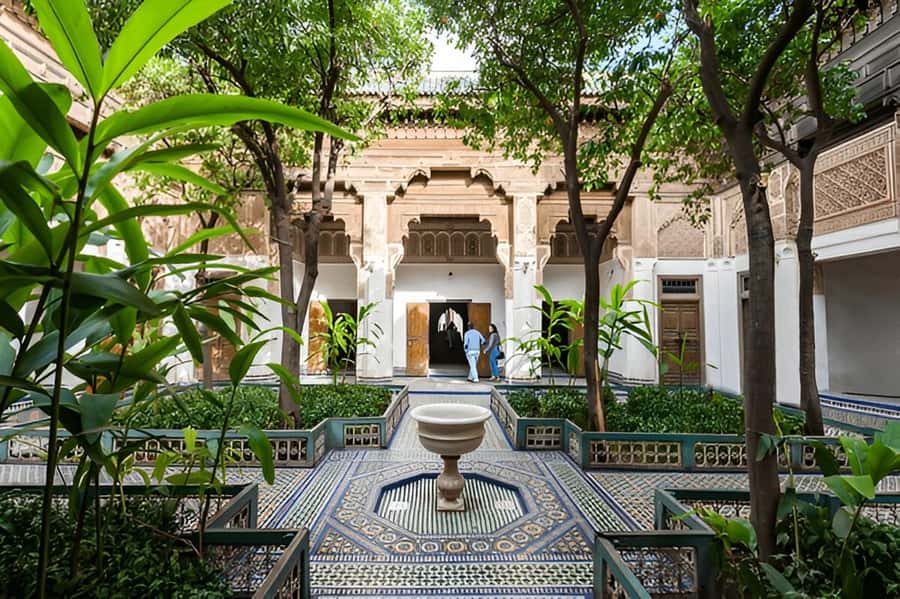
The palace is arranged around courtyards and a garden system with serious size: a 2-acre garden at the center of it all. Instead of treating rooms as isolated boxes, the layout uses outdoor space as part of the design. That’s why Bahia feels like a walk through architecture, not just a museum stop.
Here’s what you should expect to actually see as a visitor:
- The public can access only certain parts of the palace. You’ll visit areas connected to the Sultan’s favorite concubine, plus key public rooms like the Council Chamber and the Central Courtyard.
- The palace includes a mix of private spaces in a broader “maze” of apartments (often described as secret or tucked away), but the tour route focuses on the sections open to visitors.
In the Council Chamber, look for the tiled wall surfaces and the illuminated cedarwood ceiling. That combo is the kind of detail that makes you slow down even when the clock isn’t on your side. Then you move to the Central Courtyard, where the floor is paved with marble and decorated with intricate zellij tiles. Ornate fountains are also part of the courtyard scene, and together they create the feel of a palace that was designed to breathe with water and light.
One more detail that I really like about Bahia: it’s often described as having a somewhat haphazard arrangement of internal spaces that open onto the courtyards. That can sound chaotic on paper, but on-site it helps explain why the place feels theatrical. You turn a corner, and a new courtyard perspective appears.
Saadian Tombs: Marble Mausoleums With Cedar and Stucco Fine Lines
Next comes the Saâdian Tombs, tied to the Saadian dynasty and the reign of Sultan Ahmad al-Mansu. If you’re coming from the brightness of Bahia’s decorative tiles and fountains, the tombs feel like a tonal shift—less about outdoor spectacle and more about quiet, precision.
The tombs are known for the architectural lines being clean and controlled, paired with delicate decoration. Instead of looking at one surface, you start noticing how materials work together. You’ll see cedar wood and stucco details paired with marble mausoleums, and the ensemble is associated with memorials for about 60 members of the Saadi Dynasty.
Even if your tour time at the tombs is limited, I’d spend your attention on two things:
- How the decorations frame the space rather than covering everything randomly.
- How the building proportions feel—these tombs are described as having pure, clear lines, which makes the whole setting read as intentional.
This stop has a different kind of payoff than Bahia. Bahia is made for visual surprise. Saadian Tombs are made for architectural focus. If you like design details—woodwork, plaster finishes, and how light behaves in stone spaces—you’ll likely enjoy it.
Price and Logistics: The $56 Rate Plus Entrance Fees
The listed price is $56 per person for a half-day, three-hour tour with hotel pickup included (for centrally located hotels). That pickup matters in Marrakech because getting around efficiently can eat time, especially if you’re staying near the old Medina edges.
But here’s the key value math: entrance fees are not included. On a short tour, that can affect how much you feel you get for the price. One recurring caution in the feedback I saw is that ticket costs can add up quickly for each monument you enter, so it’s smart to budget for extra payments on arrival.
Also, keep expectations aligned with the schedule. Some people felt the guide’s pace could be rushed, with explanations delivered quickly at each stop. With only three hours on the clock, you’re likely to get the highlights rather than slow storytelling.
There’s one more practical consideration: a few comments flagged that guides may lead the group into shops at the end of the tour. If you hate being pressured, keep it simple—browse only if you want, and feel free to decline purchases. A good guide should still be respectful either way, but you may want to mentally prepare for a sales-heavy follow-up.
One last logistics note: if you dislike early starts, double-check the exact pickup time for your date. In some feedback, the tour started earlier than expected, and the overall experience felt too short as a result.





Who This Tour Is Best For (and Who Should Choose Something Else)
This tour works especially well if:
- You’re visiting Marrakech for a short stay and want a high-impact highlights route
- You care about Marrakech’s major monuments without having to plan ticket lines and navigation
- You love architectural details like minarets, courtyards, zellij tiles, cedar ceilings, and the material pairing in historic buildings
It may feel less satisfying if:
- You want a more balanced mix of old and modern city areas. There was at least one complaint that the modern part of Marrakech wasn’t included.
- You need lots of time in each site. At three hours, this is a “see it, learn the core, move on” kind of format.
- You prefer very long explanations. Some people found the commentary fast and wished for more time to absorb each place.
Language is also worth noting. The tour offers a live guide in English, French, or Spanish, so you can pick what you’re most comfortable with. That can change how much you enjoy the architecture, especially in spaces where details matter.
Final Verdict: Should You Book This Marrakech Palaces and Monuments Tour?
I’d book this tour if you want a quick, well-focused taste of Marrakech’s top palace and monument highlights, especially Koutoubia and Bahia Palace. The price can feel fair because pickup is included, and the sights are the kind you’ll remember even after a busy day.
I wouldn’t call it a perfect fit if you hate ticket add-ons, need long stops, or expect the tour to cover a wider slice of the city. Entrance fees can noticeably change the total cost, and the tight schedule can make the experience feel compressed.
If you book, go in with the right mindset: this is a highlights route built for momentum, not for lingering. When that matches your style, the payoff is real.
FAQ
How long is the Marrakech Palaces and Monuments half-day tour?
The tour lasts 3 hours.
What’s included in the price?
The tour includes hotel pickup from centrally located hotels in Marrakech.
Are entrance fees included?
No. Entrance fees are not included.
What languages are available for the live guide?
The live guide is available in English, French, and Spanish.
Where do you pick up travelers staying in the old Medina?
If you’re in the old Medina in a riad, pickup is provided at a nearby location.
What do I need to bring?
Bring a passport or ID card.