REVIEW · MARRAKECH
3 Days Excursion – 2 Night to Merzouga from Marrakech
Book on Viator →Operated by Morocco City Breaks · Bookable on Viator
Golden dunes are just the payoff. This 3-day, 2-night excursion links Morocco’s big cultural stops—like the fortified Ait-Ben-Haddou caravan ksar—to the softer, slower feeling of oasis towns (Skoura and Tifilalte) before you reach the Erg Chebbi dunes near Merzouga. I love the route for how much it packs in without feeling like a checklist. I also like that pick-up is offered and many departures are driven by friendly pros such as Amine or Hakim, with regular bathroom and leg-stretch stops.
One thing to consider: the drive is long. Some people also report that certain moments come with extra-pay expectations on-site (tips/add-ons), and the time you get at each stop can feel short.
In This Review
- Key things to know before you go
- Why this Marrakech to Merzouga route feels like more than a desert trip
- Price and what $117.46 really buys you
- Day 1: Ait-Ben-Haddou first, then Dades Gorges sunset
- Ksar of Ait-Ben-Haddou
- Ouarzazate: Memoire de Ouarzazate (movie studios if weather permits)
- Dades Gorges: a 25 km valley that puts on a show at sunset
- Day 2: Tinghir palms, Erfoud dates, and Rissani’s Alawite roots
- Tinghir: palm grove town with built-in viewing points
- Erfoud: dates, fossil stone, and the last big stop before the desert
- Rissani: Moulay Ali Cherif mausoleum and the Alawite lineage
- When the itinerary turns into desert time (Erg Chebbi and Erg Chabi)
- Overnight reality: hotels, desert tents, and what to pack
- The long minibus factor (and how to handle it gracefully)
- The people element: why guides like Amine and Hakim can make or break it
- Who this trip suits best (and who should think twice)
- Practical FAQ for planning your 3-day Merzouga swing
- FAQ
- What time does the tour start, and where do we meet?
- How long is the excursion to Merzouga?
- Is pick-up offered from my hotel?
- What’s the price per person?
- What tickets or entrance fees are included?
- Is lunch included?
- How big is the group?
- Is free cancellation available?
- Should you book this 3-day Marrakech to Merzouga trip?
Key things to know before you go
- Ait-Ben-Haddou on a real caravan route: A fortified 15th-century ksar tied to traders traveling between Timbuktu and Andalusia via Marrakech and Tangiers.
- Dades Gorges at sunset timing: A 25 km stretch where the rock tones change fast—this is one of the trip’s best “views with meaning” moments.
- Todra area meets palm groves: Tinghir and the surrounding gorge scenery are tied to palm gardens and layered town life around older residences.
- Erg Chebbi desert time: You’re set up for sunset and classic desert exploration options (camel/quads are mentioned often).
- Not all entrances are included: Ait-Ben-Haddou and the Ouarzazate cinema/casbah museum side are listed as admission not included.
Why this Marrakech to Merzouga route feels like more than a desert trip
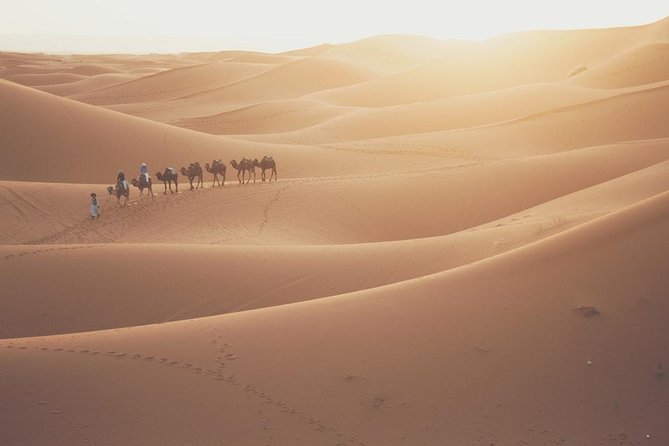
Merzouga gets all the attention, sure. But the best part of this excursion is the “in-between” Morocco you travel through on the way there and back. You pass oasis country (Skoura), rose-growing towns (Kalaat M’gouna), and the rose-and-river scenery feel that sits between big mountain sections and the start of the desert world. That change of environment is the whole point.
I like how the itinerary uses geography like a story: fortified trading towns give you a sense of why the region mattered; gorges and valleys show how people built and lived where water and stone shape everything. Then the dunes arrive, and the trip stops feeling like sightseeing and starts feeling like a transition.
You also get a practical bonus: with a max group size of 14 and pick-up offered, you’re not stuck in a massive crowd. It’s still a minibus-style day, but it’s small enough that you can actually ask questions, especially about what you’re seeing and what to watch for.
You can also read our reviews of more evening experiences in Marrakech
Price and what $117.46 really buys you
At $117.46 per person for an approximate 3-day / 2-night excursion, the value comes from three things: transport, multiple overnight segments, and a full corridor of major stops packed into limited time.
Here’s the catch. This price is not a full “everything-included” bundle. Some entrances are explicitly not included:
- Admission tickets for Ait-Ben-Haddou are not included.
- Admission tickets for Musee Theatre Memoire de Ouarzazate are not included.
- Lunch at Ouarzazate is not included.
Meanwhile, some stops are listed as admission free (like Dades Gorges, plus Tinghir, Erfoud’s stops, and the Rissani mausoleum/souk area). So the cost isn’t just one lump fee. It’s more like: you’re paying for the vehicle and guiding time through the corridor, and the few big-ticket entrances are on you.
My practical take: if you budget a little extra for entrance fees and one sit-down lunch, the price still tends to make sense. If you hate any situation where you might pay extra on-site, then this kind of route can feel stressful. The best mindset is simple—plan your budget, carry cash for small extras, and ask at the start what’s included vs. not.
Day 1: Ait-Ben-Haddou first, then Dades Gorges sunset
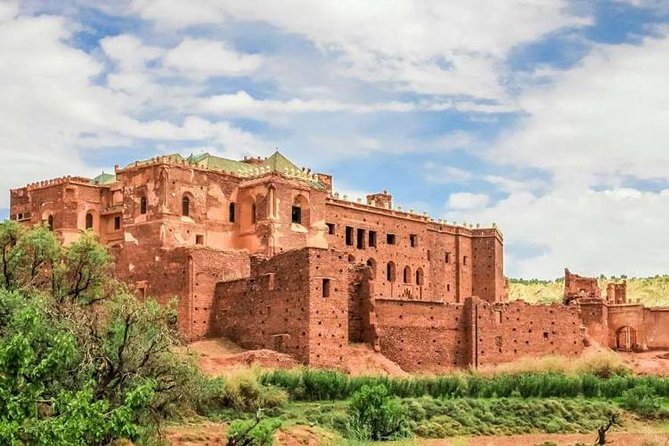
Ksar of Ait-Ben-Haddou
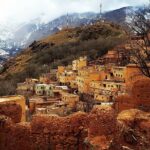
Ait-Ben-Haddou is one of the most preserved fortified villages in southern Morocco, and it’s easy to see why it’s constantly filmed. It was built in the 15th century by the tribe of Aït Aïssa for caravan dealers traveling from Timbuktu to Andalusia via Marrakech and Tangiers. That trade route context changes your whole perspective—this isn’t just architecture, it’s infrastructure.
You get about an hour here. That’s not enough time to wander every lane slowly, but it’s long enough to understand the layout and spot the defensive logic of the walls and towers. It’s also a place where weather matters: bright sun brings out texture; softer light makes details feel flatter and easier to read.
Tip: wear shoes that handle uneven stone. You’ll be stepping up and down more than you expect.
Admission for Ait-Ben-Haddou is not included, so count on that being an extra cost.
Ouarzazate: Memoire de Ouarzazate (movie studios if weather permits)
Next you head toward Ouarzazate for a stop at Musee Theatre Memoire de Ouarzazate. This is tied to the region’s film history—movie studios and kasbah scenery can be part of the visit if conditions allow.
You get about an hour. Again, not a long deep-study slot, but enough to see how Ouarzazate became a production hub and how the local architecture fits the “movie-ready” look.
Ticket admission is listed as not included here too, so this is another spot where your budget should be flexible.
A few more Marrakech tours and experiences worth a look

Dades Gorges: a 25 km valley that puts on a show at sunset
Day 1 ends in the Dades Gorges, a 25 km long valley between Boumalne and Imdiazen. The setting is famous for its dramatic rock shapes, and the Wadi Dadès (the watercourse) runs through limestone plateaus that shape the whole visual rhythm.
What makes this stop worth the drive time is the timing. The trip specifically notes sunset—because in the gorges, the light changes quickly and the colors shift with it. You’re not just looking at scenery; you’re watching the environment do the work.
Admission for Dades Gorges is free, so no surprise fees here.
Day 2: Tinghir palms, Erfoud dates, and Rissani’s Alawite roots
Day 2 is where the trip balances “big sights” with more human-scale stops. You’ll notice a pattern: shorter photo-walk moments paired with places that explain how people live in the edge zones between farms and desert.
Tinghir: palm grove town with built-in viewing points
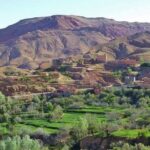
Tinghir is known for its palm grove and its connection to the Todra Gorge area. The town sits in tiers around a promontory, with ruins of an old residence of Glaoui dominating the historical feel of the hill.
You’ll have about 30 minutes. That means: don’t expect a full town exploration. Instead, use the time for orientation—walk a little, look for the tiered layout, and take in the palm rhythm that frames the gorge world.
Admission is free.
Erfoud: dates, fossil stone, and the last big stop before the desert
Then comes Erfoud, located in the huge palm grove of Tafilalet. It’s described as the Moroccan capital of dates, and it’s the kind of place where the farming economy is visible right away through date palms.
Two useful context points:
- It’s tied to a dates celebration in October with folk dances and competitions.
- It’s described as the last big city before the desert when coming from the north.
You also stop for La Pierre d’Erfoud, a nod to local stone/fossil craft in the region. You get about 30 minutes—enough time to look at the material and understand why it’s marketed locally.
Admission is free.
Rissani: Moulay Ali Cherif mausoleum and the Alawite lineage
Finally, you reach Rissani with a stop at the Moulay Ali Cherif Mausoleum. It’s described as a holy city and the cradle of the Alawite dynasty, meaning you’re seeing a place tied to the royal family’s religious roots.
Rissani also has a rich souq craft atmosphere and ksour (traditional fortified settlements) around the city, which help connect this day’s stops into a coherent “Saharan atmosphere” story.
You get around 30 minutes, and because it’s a religious/cultural site, keep your tone respectful and dress appropriate.
Admission is free.
When the itinerary turns into desert time (Erg Chebbi and Erg Chabi)
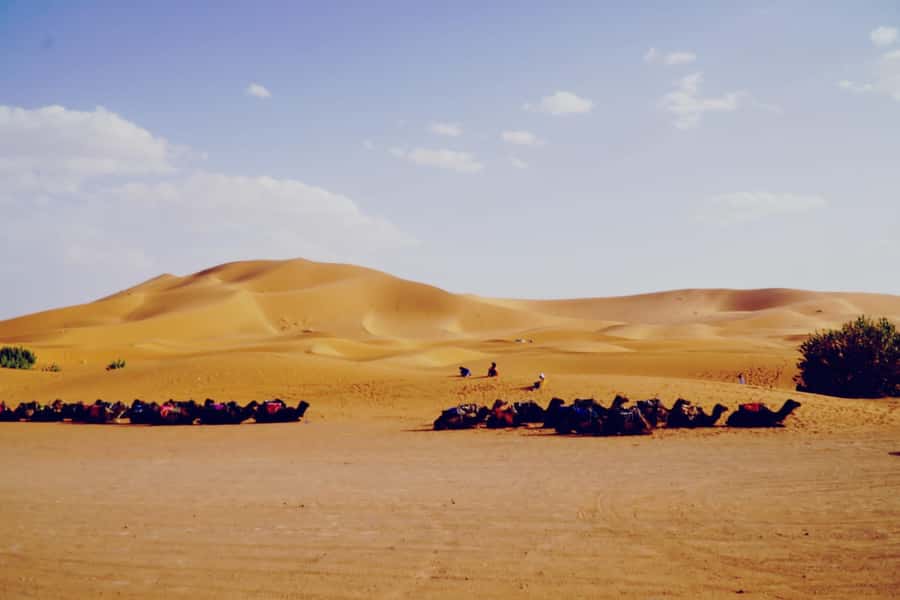
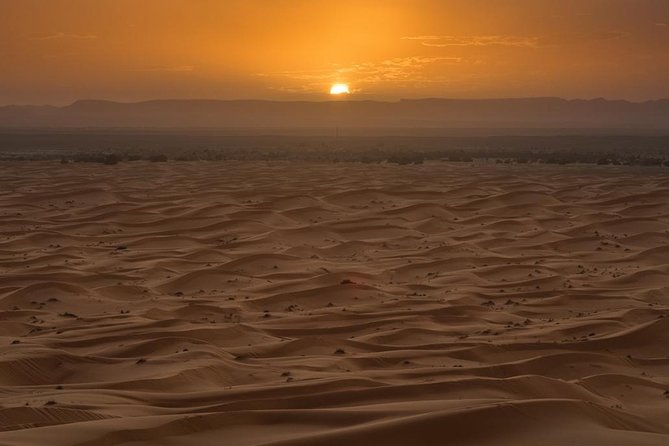
The overview points to reaching Erg Chabi in Merzouga, with the desert experience focused around the Erg Chebbi dune area. This is the part most people remember, and it’s also the part that makes sense after two full days of valleys, oasis towns, and fortified stops.
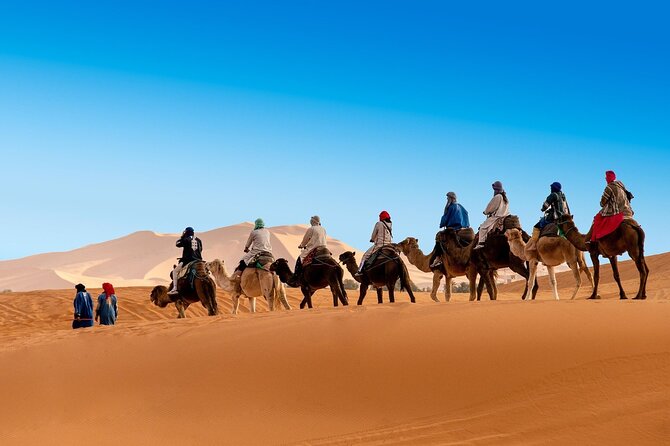
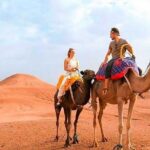
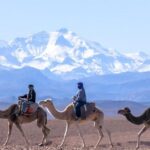
This is when you’re typically set up for sunset and some form of Sahara exploration. Camel rides and quads are specifically mentioned as enjoyable desert activities, and sunset over the dunes is repeatedly called out as worth it.
My practical advice: bring layers. Desert nights cool down fast. Even if daytime feels warm, you’ll want something for the evening when you’re outside for sunset and then later for camp time.
Also, treat the camp experience as culture, not luxury. Some people describe the desert lodging as Berber-style tents and note it’s comfortable, while others say hotel or camp accommodations were basic. Translation: don’t book this expecting a resort room.
Overnight reality: hotels, desert tents, and what to pack
Your trip includes two nights total. One of those nights will be a hotel stay on the route; the other is in the Merzouga desert camp area. The descriptions you’ll see are consistent: lodging tends to be basic rather than fancy, and camp stays can be more “traditional setup” than hotel comfort.
That’s not automatically bad. It just means you should pack and plan like a practical desert guest:
- Bring a warm layer for night time.
- Keep travel essentials easy to reach during long ride days.
- If you’re sensitive to room conditions, don’t assume perfect temperature control.
I’d also keep expectations aligned with the nature of the trip. This is a corridor tour: you’re paying to move through major regions and reach Erg Chebbi, not to sit around in high-end facilities.
The long minibus factor (and how to handle it gracefully)
A 3-day excursion from Marrakech to Merzouga is, by definition, a lot of road time. Some people love it. Some people feel the fatigue when stop times are short and the drive stretches on.
So here’s the balance:
- The route does include regular stops so you can stretch and use the bathroom.
- The downside is that the “road percentage” can feel high, especially if you’re hoping for long museum-style visits at every single stop.
How you survive this depends on you. I recommend you treat this trip like a road-and-scenery experience:
- Eat a real breakfast before you go.
- Carry water and small snacks you can access without asking.
- Use the pauses to reset your body. Don’t wait until you’re desperate.
And if you’re very time-sensitive—like you need long visits, slow pacing, and lots of guided inside time—then consider whether a more centered desert-only option might fit you better.
The people element: why guides like Amine and Hakim can make or break it
In Marrakech day trips, a good driver is more than “just transport.” On this route, they’re also your navigator through the stops, your translator for what you’re seeing, and your helper with small timing issues.
You’ll see that many passengers praise drivers such as Amine and Hakim for being kind, polite, and willing to stop for what the group needs (within reason). That matters because the corridor is wide, the timing is tight, and your enjoyment depends on whether those roadside moments feel smooth or chaotic.
Still, there have been complaints in the wild about added charges or “extras.” I can’t claim those happen on every departure. But you should act as if they could. Ask upfront what costs money and what’s free. Keep it simple: clarify entrance fees and any optional activities before you’re standing in front of a gate.
Who this trip suits best (and who should think twice)
This is a strong choice for you if:
- You want a fast, organized route through Morocco’s oasis-and-gorge belt and end in the dunes.
- You like seeing fortified architecture (Ait-Ben-Haddou) and then switching to desert scale (Erg Chebbi).
- You’re okay with basic lodging and a lot of time in the vehicle.
This may not be your best match if:
- You want luxury comfort or long, unhurried museum time.
- You dislike any chance of paying extra for entrances, a lunch stop, or optional additions.
- You get stressed when schedules feel “stop-and-go.”
Practical FAQ for planning your 3-day Merzouga swing
FAQ
What time does the tour start, and where do we meet?
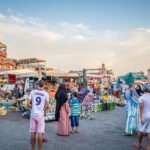
The tour starts at 8:00 am in Marrakech at Jemaa el-Fna (Jamaâ El-Fna), Marrakech 40000, Morocco.
How long is the excursion to Merzouga?
It’s listed as a 3-day excursion (approx.), with 2 nights to Merzouga.
Is pick-up offered from my hotel?
Yes, pickup is offered, and the meeting point is near public transportation.
What’s the price per person?
The price is $117.46 per person.
What tickets or entrance fees are included?
Some admissions are not included. The Ksar of Ait-Ben-Haddou and the Musee Theatre Memoire de Ouarzazate are listed as admission not included. Dades Gorges and several other listed stops are admission free.
Is lunch included?
No. Lunch in Ouarzazate is listed as not included in the price.
How big is the group?
The maximum group size is 14 travelers.
Is free cancellation available?
Yes. You can cancel up to 24 hours in advance for a full refund.
Should you book this 3-day Marrakech to Merzouga trip?
If your priority is a well-paced-but-fast corridor experience—Ait-Ben-Haddou, gorges, oasis towns, then desert sunset in the Erg Chebbi area—this tour format is a solid fit. The price works best when you’re comfortable with long drive days, basic lodging expectations, and a bit of budgeting for entrances and one lunch.
I’d book it if you want Morocco’s “wide-angle” story in just a few days. I’d think twice if you need minimal road time or hate the idea of potential extra-on-site costs. In other words: go for it if you want the journey as much as the dunes—and pack smart for the temperature swings at night.