REVIEW · FEZ
Tour guide in the old city of Fez
Book on Viator →Operated by CASACADO VOYAGEURS · Bookable on Viator
Fez makes sense with the right guide. On Rachid’s 2-hour walk through Fez el-Bali, you get help reading the medina maze, with stops tied to real local life, big landmarks, and the kinds of details you’d miss on your own.
I especially like two things: Rachid keeps the pace easy and the route logical, and you also get access to key sights such as Kairaouine Mosque and Dar Batha Museum without wasting time hunting entrances or explanations.
One heads-up: some views are outside-only (like the Royal Palace gates), and not every site’s admission is included, so check what you’ll pay separately as you go.
In This Review
- Key points to know before you go
- Getting oriented in Fez el-Bali on a 2-hour walking route
- Kairaouine Mosque: the 859 AD starting point for Fez’s story
- Sidi Ahmed al-Tijani Zawiya: education, commemoration, and a turquoise minaret
- Dar el Makhzen gates: Morocco’s royal doors you can view, not enter
- Al-Attarine Madrasa and Souk Attarine: perfume trade meets Marinid architecture
- Bab Boujloud: the famous gate that helps you anchor the maze
- Fes el-Bali: the medina split by a river and what that means for you
- Dar Batha Museum: the calm break with thousands of objects
- Chouara Tannery: a major craft stop behind ramparts
- Moulay Idriss II mausoleum: outside viewing rules you should expect
- Price and value at $29.08 with mostly included admissions
- Practical tips for a smoother medina day
- Who should book this Rachid-led medina walk
- Should you book Rachid Guide Tour in Old Medina Fez?
- FAQ
- How long is the tour?
- How much does it cost?
- Do I need a paper ticket?
- What is the maximum group size?
- Which stops are included on the route?
- Is admission included for all sites?
- Can I bring a service animal?
- Is it mostly walking?
- Can foreign visitors enter the Moulay Idriss II mausoleum?
- What’s the cancellation policy?
- When will I receive confirmation?
Key points to know before you go
- A small group (up to 10 people) makes it easier to hear explanations in narrow lanes.
- Tickets help you get in faster at many stops during the 2-hour route.
- Kairaouine Mosque (completed 859 AD) is the spiritual centerpiece of the day.
- Royal Palace gates give you the iconic mosaic-and-gold look, even though you cannot enter the grounds.
- Souk Attarine connects to Al-Attarine Madrasa through perfumes, herbs, and the old perfume-spice trade.
- Dar Batha Museum is a welcome break with thousands of collected art and craft objects.
Getting oriented in Fez el-Bali on a 2-hour walking route
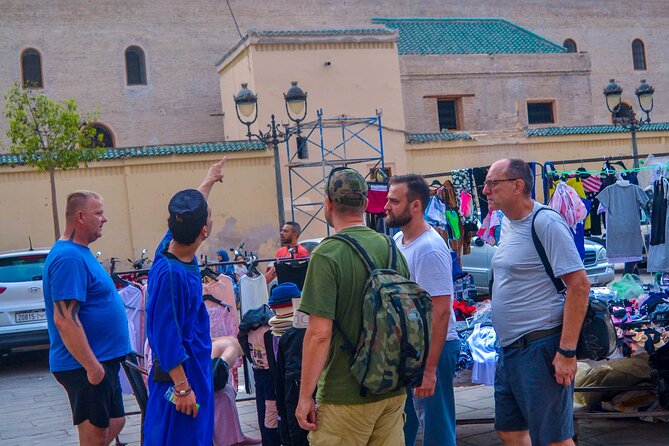
Fez is one of those cities where you can walk for hours and still feel like you’re wandering. This tour solves that by following a route that hits the medina’s most important touchpoints while keeping you moving at an easy, smooth pace. It’s listed as only walking, and it’s designed to be fun and fit for everyone.
The guide matters here. Rachid is a local who focuses on history and culture, but also on daily life—how markets work, how crafts survive, and where people actually spend time. With a maximum group size of 10, the tour doesn’t feel like a shuffle through crowds.
Cost-wise, $29.08 per person is reasonable if you look at what you’re getting: multiple major landmarks, plus several admissions included. You’re also using a mobile ticket, which is convenient in a place where getting paperwork out can slow things down.
You can also read our reviews of more guided tours in Fez
Kairaouine Mosque: the 859 AD starting point for Fez’s story
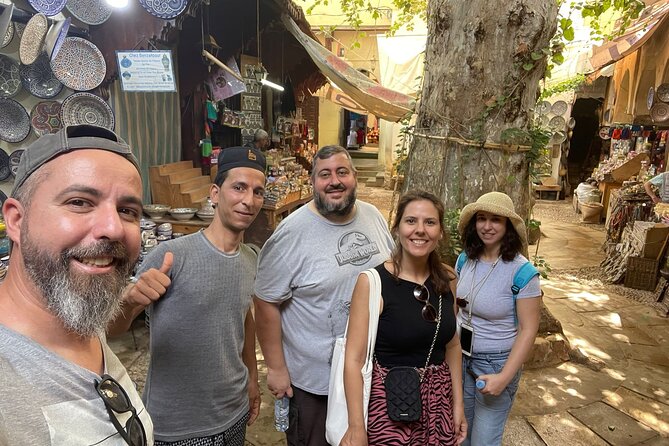
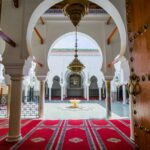
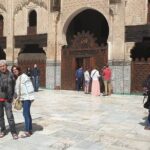
The day begins at Kairaouine Mosque (also spelled Al-Qarawiyyin Mosque). This is the kind of place you only truly understand with someone pointing out what you’re looking at. Construction finished in 859 AD, ordered by Fatima bint Muhammad al-Fihri, and the name ties to the Al-Qarawiyyin community—refugees connected to Kairouan.
What I like about this stop is that it’s not just a single photo moment. The mosque has seventeen doors and two wings, and it grew over time thanks to later rulers. The guide’s context on additions—Zenati princes with help from the Andalusian Umayyads, then expansions by the Almoravids—turns the building into a timeline you can feel.
Admission is included for this stop, which helps because medina sites can be confusing if you’re arriving cold.
Sidi Ahmed al-Tijani Zawiya: education, commemoration, and a turquoise minaret
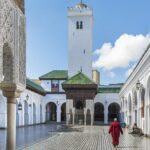
Next comes Sidi Ahmed Al-Tijani Zawiya (also called Zawiya Tijaniya Al Kobra). A zawiya is an Islamic religious complex tied to education and commemoration, so it’s different from a “tourist attraction” vibe. This one sits inside Fes el-Bali, close to the University of Al Quaraouiyine.
The site is dedicated to Sheikh Ahmad al-Tijani, founder of the Tijaniyyah order from the 18th century. He is buried at the complex, which adds weight to why people visit. From the street, it’s recognizable by its ornamented facade and a turquoise minaret, a color detail that helps your brain file it away as you move through the medina.
Admission is included here too, so this is another stop where the tour reduces friction.
Dar el Makhzen gates: Morocco’s royal doors you can view, not enter
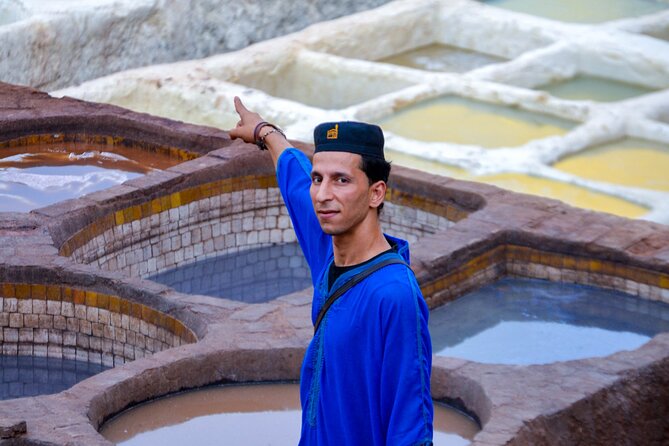
The Royal Palace of Fez (Dar el Makhzen) is built in the 1960s, and you’ll notice the bold design right away: colorful mosaic-colored architecture, landscaped gardens, and golden doors with huge handcrafted copper elements.
Here’s the catch, and it’s a good thing to know up front: as a tourist, you can’t explore the palace grounds. Instead, you view it from one of seven impressive gates, each marked by Moroccan tiles and carved wood. That means you’re not seeing everything—but you are seeing the look people come for.
For me, the value is how the guide frames what you can and cannot do. In Fez, rules and access vary by site, and a guide who explains the boundaries helps you feel in control instead of shut out.
Al-Attarine Madrasa and Souk Attarine: perfume trade meets Marinid architecture
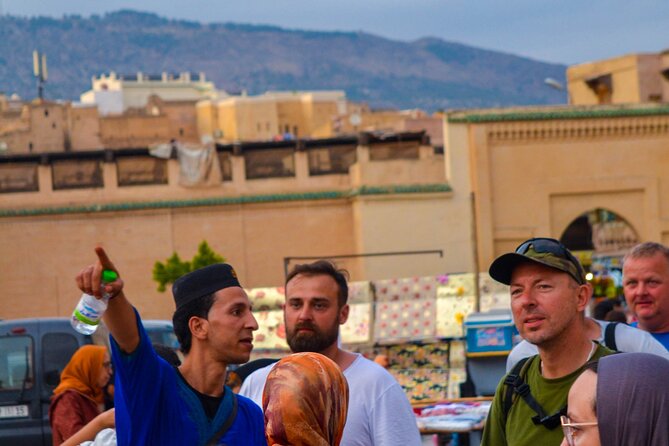
Al-Attarine Madrasa is one of the star Marinid buildings near Al-Qarawiyyin Mosque. It was built by Marinid sultan Uthman II Abu Said between 1323 and 1331 (with dates given as 1323–5). The name connects directly to the market: Souk al-Attarine, the spice and perfume market.
This is a stop where architecture tells economics and culture. The Marinids built many madrasas, but Al-Attarine is described as a high achievement, using rich, harmonious decoration and making efficient use of limited space.
Important detail: admission is not included for this madrasa stop. So if you’re counting on the tour price to cover everything, this is the one place to expect a separate ticket.
Right after that theme, you’ll be in Souk Attarine, the antique market for perfumers. The connection is practical: herbs and medicinal plants are part of what you’ll encounter, and the market ties to the older role of traditional medicine commerce. Today it’s shops, spices, perfume trade, and the sensory overload of a working market. Two large doors close by evening, so the timing can matter if you’re sensitive to crowd intensity.
You can also read our reviews of more city tours in Fez
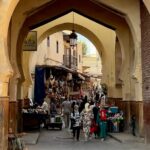


Bab Boujloud: the famous gate that helps you anchor the maze
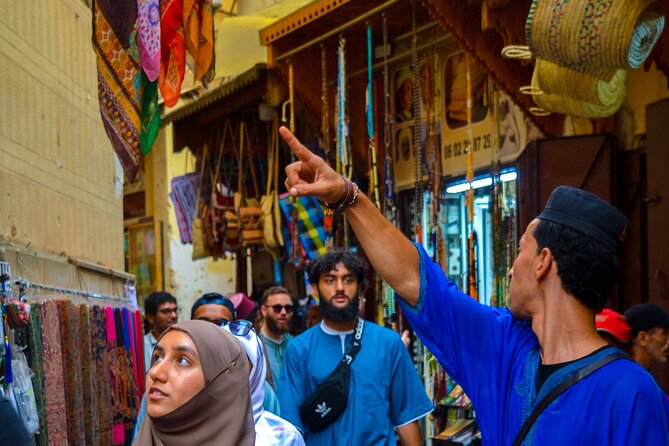
Bab Boujloud (Bab al-Jund / Bab Bu Jeloud) is one of Fez’s most famous gates in the wall around the old city. It’s on the northwestern side and next to Al-Basha Al-Baghdadi Square, which is handy for orientation once you’ve been shown where it sits.
The tour frames it as more than a photo backdrop. Bab Abi El Guind is often considered the main entrance to Fez, and Bab Boujloud becomes your reference point for everything that follows inside the medina.
Admission ticket is listed for this stop, and it fits the overall value of the walk: major landmarks, not random corners.
Fes el-Bali: the medina split by a river and what that means for you
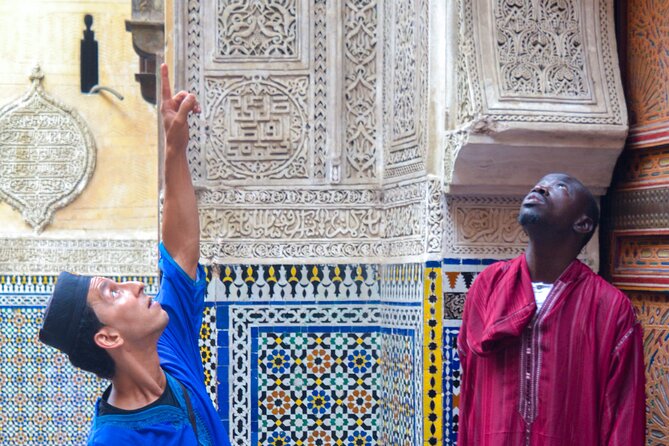
Fes el-Bali is the oldest neighborhood and one of the biggest “still intact” ancient city areas in the world. Streets here are pedestrianized and narrow, and the medina keeps a feel that many cities lose.
A key insight the guide helps you understand: the branching streets split into two areas separated by a meandering river. On the north bank, you’re more likely to find historical monuments and markets. On the south bank, you’ll find the lanes people use day to day, including narrow lanes that are good for souvenirs and a more local feel.
What I like about including this area for about an hour is that it gives you time to adjust. First you see the landmark doors; then you start learning how movement works—where the lanes funnel, where you can slow down, and where shortcuts open up.
Also, this is where you’re more likely to run into small craft activity. The tour describes opportunities to meet local artisans and craftsmen who keep traditional crafts alive. In practice, that tends to mean you’re not just looking—you’re hearing what people do and why it matters.
Dar Batha Museum: the calm break with thousands of objects
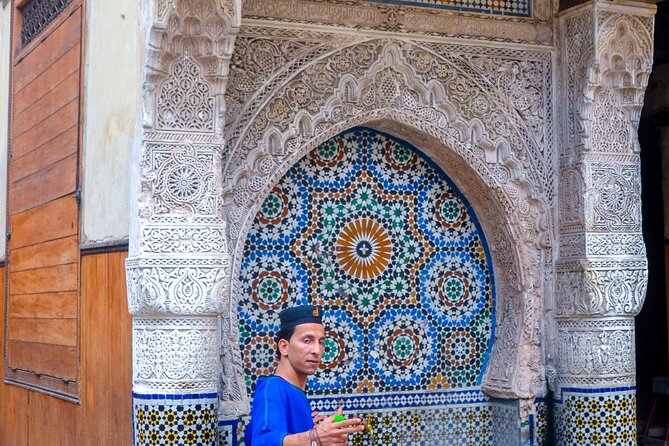
Dar Batha Museum (Dar Al Batha) is a smart mid-day shift from street-level chaos. The palace was completed by Sultan Moulay Abdel Aziz in 1897, after his father Mawla Hassan started the work. It originally served as a summer residence for royal receptions and later became a regional museum of arts and customs in 1915.
The museum’s scale is big—about a hectare—and it holds roughly 6,000 pieces. You’ll find manuscripts, astrolabes, copper, wood, and gypsum pieces, plus marbles, coins, ornaments, clothing, textiles, and ceramics.
There’s one room that gets special attention: the Brick Room. Even if you’re not a museum person, this stop is practical because it gives your feet a reset and your brain a pattern. Instead of only seeing objects as souvenirs, you get context for what they are and how they fit into craft traditions.
Admission is included for this stop, which makes the museum feel like part of the tour value, not a pricey add-on.
Chouara Tannery: a major craft stop behind ramparts
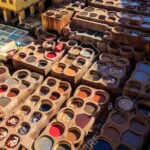
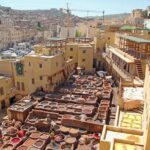
Chouara Tannery is one of the famous leather stops tied to Fez’s old artisan economy. Fez is described as the third largest city in Morocco, founded in the 8th century, and the medina’s tanneries sit behind high ramparts in a dedicated traders and artisan area.
The tannery area (tanners’ souk) is said to contain three ancient tanneries, with the largest and oldest being Chouara. That matters because it’s not just a “look at the vats” stop—it’s part of a system that shaped the surrounding markets for centuries.
The tour includes an admission ticket here. In a city where access and rules can change, having this handled makes a difference.
Moulay Idriss II mausoleum: outside viewing rules you should expect
The last key historical stop is the Zaouia of Moulay Idriss II, tied to the Mausoleum of Moulay Idriss (Idris II). This is a monument that authorities keep tightly controlled for visitor access.
Here’s the rule you’ll want to plan around: foreign tourists are not allowed to enter the mausoleum. Instead, you’ll take pictures from outside. The provided info also notes that authorities don’t provide much for visitors—just the date of birth of Idris II engraved on a marble rectangle at the gate.
For Moroccan tourists, entry is possible, and the tomb is described as being surrounded by a wooden frame and a red dress with Quranic verses. But as a foreign visitor, you should set expectations that your experience is about the exterior viewing and the area’s atmosphere, not interior access.
Admission ticket is included for this stop, and the tour keeps the time efficient—about 10 minutes.
Price and value at $29.08 with mostly included admissions
At $29.08 per person for about 2 hours, the math only works if the tour covers enough ground and enough paid entries. This route hits multiple major sites, and many stops list admission included: Kairaouine Mosque, Sidi Ahmed Al-Tijani Zawiya, the Royal Palace gates viewing, Bab Boujloud, Fes el-Bali, Souk Attarine, Dar Batha Museum, Chouara Tannery, and Moulay Idriss II area.
The one clear exception stated is Al-Attarine Madrasa, where admission is not included. So budget a small extra amount for that stop if you want to go in.
The other value factor is the guide’s approach. The tour description emphasizes responsible tourism: sustainability, ethical practices, and supporting local businesses. That fits the practical side too. When someone is focused on local support, you’re less likely to get pushed toward random sales stops, and you’re more likely to understand what you’re seeing.
Practical tips for a smoother medina day
Fez medina days are all about small choices. A few practical points can make the difference between rushed and enjoyable:
- Wear comfortable shoes. The tour is an easy walk, but Fez streets are narrow and uneven.
- Ask about admissions as you go. Al-Attarine Madrasa has admission not included, so confirm payment timing on the spot.
- Use the mobile ticket. That’s listed as part of the experience setup, and it saves time at entrances.
- Go in with flexible expectations. Some big sights are view-from-the-gate experiences, like the Royal Palace and the Moulay Idriss mausoleum area for foreign visitors.
- If anything feels unclear, speak up early. There’s at least one negative incident reported about lack of guidance and money returned later, so the best protection is to ask clear questions before you pay for any extra admission.
Who should book this Rachid-led medina walk
This is a strong choice if you want:
- a 2-hour route with major landmarks,
- a guide who explains not just buildings, but how markets and craft traditions work,
- small-group pacing and a walking tour that’s described as easy and smooth,
- and responsible tourism values that focus on supporting local businesses.
If you’re someone who likes quiet, long museum time, you may wish for more hours. But if you want a smart starter route that helps you understand Fez quickly, this fits well.
Should you book Rachid Guide Tour in Old Medina Fez?
Yes—if you’re okay with the fact that some sites are outside-only views and one stop (Al-Attarine Madrasa) may require extra admission. At $29.08 for roughly 2 hours, you’re paying for both access and context, and the route covers the kinds of landmarks that anchor a first-time Fez visit.
Book this if you want a guided, explain-it-to-me walk through Fez el-Bali’s key spiritual sites, markets, crafts, and a museum break. Skip it only if you strongly prefer fully indoor access or you want to control every stop on your own with no ticket handoffs.
FAQ
How long is the tour?
It runs for about 2 hours.
How much does it cost?
The price is $29.08 per person.
Do I need a paper ticket?
No. The tour uses a mobile ticket.
What is the maximum group size?
The tour has a maximum of 10 people.
Which stops are included on the route?
The tour includes Kairaouine Mosque, Sidi Ahmed Al-Tijani Zawiya, the Royal Palace of Fez (viewed from gates), Al-Attarine Madrasa (with admission not included), Bab Boujloud, Fes el-Bali, Souk Attarine, Dar Batha Museum, Chouara Tannery, and the Zaouia of Moulay Idriss II.
Is admission included for all sites?
Most stops list admission ticket included, but Al-Attarine Madrasa is marked as not included.
Can I bring a service animal?
Yes. Service animals are allowed.
Is it mostly walking?
Yes. The experience is described as only a walk, and it’s listed as easy and smooth for most people.
Can foreign visitors enter the Moulay Idriss II mausoleum?
No. Foreign tourists are not allowed to enter the mausoleum and can only take pictures from outside.
What’s the cancellation policy?
Free cancellation is available. You can cancel up to 24 hours in advance for a full refund; within 24 hours, the amount paid is not refunded.
When will I receive confirmation?
Confirmation is received within 48 hours of booking, subject to availability.