REVIEW · AGADIR
Agadir: Unleash Your Adventure with Electric Bicycles!
Book on Viator →Operated by Pikala Bikes · Bookable on Viator
Electric bikes in Agadir can feel like a shortcut to the city’s soul. This one pairs Pikala Bikes guidance with neighborhood stops that go beyond the usual checklist. You get to move fast without missing the details, thanks to the steady pace and the chance to chat about everyday Morocco.
I especially like the combination of architecture and culture—from the mosaics at Mohamed V Mosque to the modernist earthquake-era buildings you’ll recognize right away. The second big win for me is the human side: young guides share what life is like growing up in Morocco, including how religion, family, and modernization show up in daily conversations.
One consideration: a good tour depends on tight group management, and there’s at least one cautionary note about losing someone at traffic lights. If you book, I’d plan to stay close to your guide and do a quick headcount check at each stop.
In This Review
- Key Highlights to Know Before You Go
- Electric Bike + Pikala Guides: The Real Hook in Agadir
- Price and Timing: Is This a Good Deal at $32.98?
- Where You Start: Banque Populaire and a Ride That Moves With You
- Route Highlights Around Agadir’s Earthquake-Era Architecture
- Mohamed V Mosque: Mosaics, a Minaret, and Basic Etiquette
- Main Post Office: Modernist Agadir With a Big Backstory
- Caserne de Pompiers Agadir: Jean-Francois Bodin’s Geometric Fire Station
- Agadir Synagogue: Stop Outside, Learn What You Would See Inside
- Cinema Salam: A 1946 Survivor Shaped Like a Horse Saddle
- Catholic Church of Saint Anne: Coexistence After the Earthquake
- Food, Hammam, and Cafe Stops: Where Daily Life Takes Over
- Souk El Had and Talborjt: Shopping Streets With an Actual Point
- Souk El Had d’Agadir: A Market You Can Use, Not Just Look At
- Quartier Industriel: The Entrepreneur Story Behind the Streets
- Talborjt: Shops, Cafes, and Near-By Landmarks
- Royal Palace Grounds and Bank Al-Maghrib Facades
- The Royal Palace Grounds: Closed to the Public, Still Worth Noticing
- Bank Al-Maghrib: Second Branch, Modern Reconstruction, Artistic Touch
- Riding Tips That Make the Whole Tour Work
- Who This Agadir Electric Bike Tour Suits Best
- Should You Book Pikala’s Electric Bike Tour of Agadir?
- FAQ
- How long is the Agadir electric bike tour?
- What does the tour cost?
- Where do I meet, and where does the tour end?
- What’s included in the price?
- Do I get picked up from my hotel?
- Do we go inside the synagogue?
- Is cancellation free?
Key Highlights to Know Before You Go
- Electric bike ease for a 3-hour city loop, with use of the bike plus helmet or hats
- Modernist Agadir landmarks tied to the 1960 earthquake story, including the post office and fire station
- Religion-in-motion stops, with Mohamed V Mosque and Sainte Anne Church, plus a synagogue stop where you learn without entering
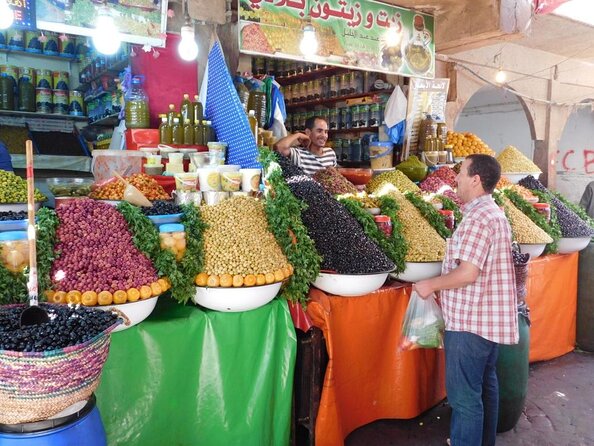
- Food and daily-life moments, including snacks, coffee or tea, and fruit shopping at the Main City Market / souk area
- Small group size (max 10 travelers), which makes conversations and pacing feel manageable
Electric Bike + Pikala Guides: The Real Hook in Agadir
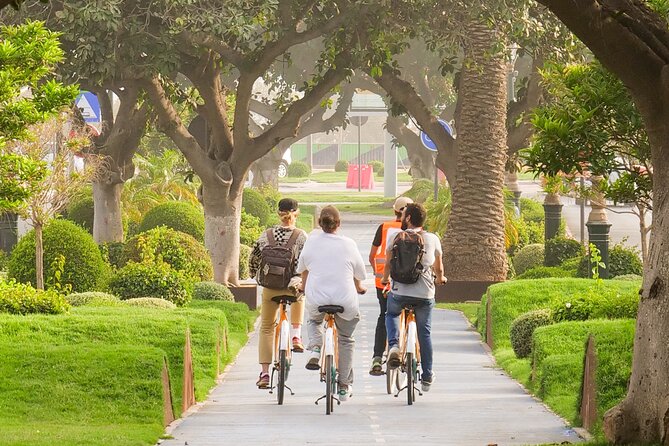
Agadir has a lot to see, but distances and street traffic can make a normal walking tour feel slow. This electric bike format changes the math. In about 3 hours, you cover enough ground to get a real sense of how the city is laid out, while still stopping often enough to look, listen, and ask questions.
What I like most is that the tour doesn’t treat culture like a museum label. It’s presented as lived experience. Your guide (with Pikala) talks through what it’s like to grow up in Morocco and how family matters, and you’ll often hear how people balance religion and modern life. If you pick up a few Arabic phrases along the way, it won’t feel like a classroom drill—it’ll feel like something you used immediately on the street.
The electric bike itself also matters for value. You’re not paying just for “getting a ride.” You’re paying for a guided circuit that mixes recognizable landmarks with practical, everyday stops—like a market moment where you can grab fresh fruit and keep your energy up for the ride.
You can also read our reviews of more tours and experiences in Agadir.



Price and Timing: Is This a Good Deal at $32.98?
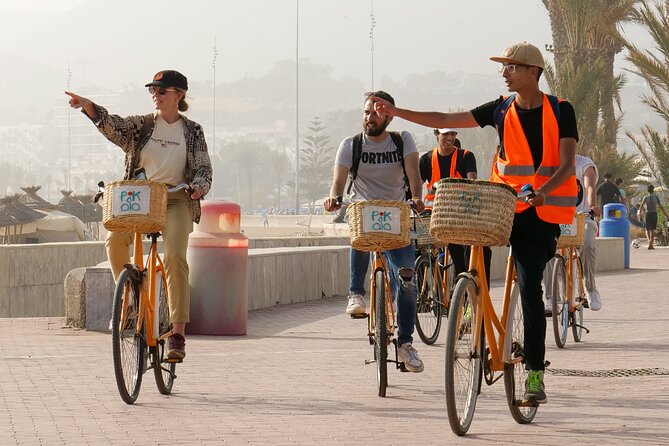
At $32.98 per person for roughly 3 hours, the price makes sense if you compare what’s included. You get use of the bicycle, bottled water, snacks, plus coffee and/or tea. You also get helmet or hats, which saves you the hassle of bringing gear in advance.
The best value part is that this is structured like a guided orientation to the city: religion, architecture, neighborhood life, and markets are all folded into one route. That’s especially useful if it’s your first day in Agadir and you want to understand the city’s layout fast.
The main tradeoff is that there’s no hotel pickup or drop-off. So you’ll want to arrive at the meeting point under your own steam. The good news: it’s near public transportation, and the tour ends back at the same place, which keeps your day tidy.
Where You Start: Banque Populaire and a Ride That Moves With You
You’ll meet at Banque Populaire (CC72+74C), Agadir 80000 and ride as a small group. Since the tour loops back to the meeting point, you don’t need to plan a tricky end-of-day transit puzzle.
Because it’s a max of 10 travelers, the ride feels personal enough that you can ask questions while you’re moving. Also, with electric assist, you don’t need athletic legs to keep up. You do still need to be comfortable riding in city traffic environments, stopping, and starting with the group.
Bring a realistic mindset: you’re not doing a long countryside trek. This is a compact, city-focused tour. If you like your sightseeing with context and motion, you’ll feel at home here.
Route Highlights Around Agadir’s Earthquake-Era Architecture
Agadir’s modern look is tied to a major rebuilding story, and this tour uses landmarks to make that theme easy to understand. You’ll be able to spot modernist forms, geometric shapes, and the way public buildings were designed to last after a shock.
Here are the key stops where the design details matter most.
Mohamed V Mosque: Mosaics, a Minaret, and Basic Etiquette
You’ll stop at Mosquee Mohamed V for about 10 minutes. It’s described as an impressive place with intricate mosaic work, a towering minaret, and a spacious prayer hall that can hold over 1,000 worshippers.
Even if you’re only stopping briefly, this is one of the places where the mood changes the fastest. Take a moment to slow down and look at the ornament details. Also, plan ahead for dress code and etiquette. If you’re unsure, go with something modest that covers shoulders and keeps legs reasonably covered. You’ll thank yourself later.
Admission is free, which is always a win on a first-day orientation tour.



Main Post Office: Modernist Agadir With a Big Backstory
Next is the Main Post Office, another 10-minute stop. The building is modernist, and you’ll learn that it was built in the aftermath of the 1960 earthquake. It’s also described as an iconic symbol of the city.
There’s extra intrigue too: rumors say the building may have been used by King Hassan II. Even if you treat that as rumor, the point is clear. This is a place where civic design and recovery history overlap, and that gives the stop more meaning than a photo moment.
Caserne de Pompiers Agadir: Jean-Francois Bodin’s Geometric Fire Station
For about 20 minutes, you’ll see the Agadir Fire Station (Caserne de Pompiers Agadir). It’s designed by architect Jean-Francois Bodin, and the building’s bold lines and geometric shapes are the star.
This stop works well if you’re the type of person who likes architecture, but it’s also practical. It’s a real emergency-service hub, so you’re seeing the city’s systems alongside its style. If you’re the kind of traveler who wonders how cities organize public safety in everyday life, this will feel more grounded than pure sightseeing.
Agadir Synagogue: Stop Outside, Learn What You Would See Inside
You’ll stop by Agadir Synagogue for about 20 minutes, and you won’t go inside. Still, the tour explains the synagogue as a landmark connected to the Moroccan Jewish community—serving worship and community gathering.
Since you’re not entering, your focus is on learning from the outside and understanding what makes it significant. The description mentions features you can picture, including stained glass windows, intricate tilework, and traditional Jewish symbols. You’ll likely get enough context to appreciate why this building matters in a multi-faith city.
Cinema Salam: A 1946 Survivor Shaped Like a Horse Saddle
This one is a quick but memorable stop: Cinema Salam, an abandoned cinema built in 1946, described as one of the few buildings that survived the earthquake. It’s connected to architect Georges Appéré, who designed it on a 1,200 m² ground.
Here’s the cool detail: the design is said to resemble a horse saddle and was made so it would be harder to fall during the catastrophe. Whether you’re a history nerd or just like architecture stories, that idea sticks. It turns a ruined building into a lesson about design and survival.
Catholic Church of Saint Anne: Coexistence After the Earthquake
For about 20 minutes, you’ll visit the Catholic Church of Saint Anne (Sainte Anne). It was built after the earthquake and is framed as another example of religious coexistence in Morocco.
The tour also points to the reality that Christians are a small minority in the country (around less than 1%, with an estimate of about 400,000 people). You won’t need a lecture to get what that means—you’ll feel it in the tone of the stop, which is meant to be respectful and calm.
The description says entry is included here, so you don’t have to juggle extra fees.
Food, Hammam, and Cafe Stops: Where Daily Life Takes Over
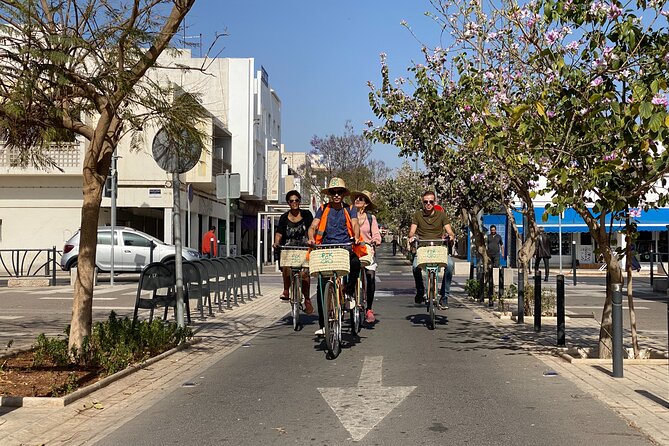
One of the reasons I’d put this tour above the typical “stand and point” sightseeing is that it includes time for food and everyday rhythm. The tour is described as featuring visits connected to local life, including a public bakery, a traditional hammam, and a local cafe.
You’ll also get snacks during the ride and coffee and/or tea included, which is smart on a day that mixes walking around sites and short biking segments. If you’re the type who gets grumpy when you’re hungry, you’ll be glad this is built in.
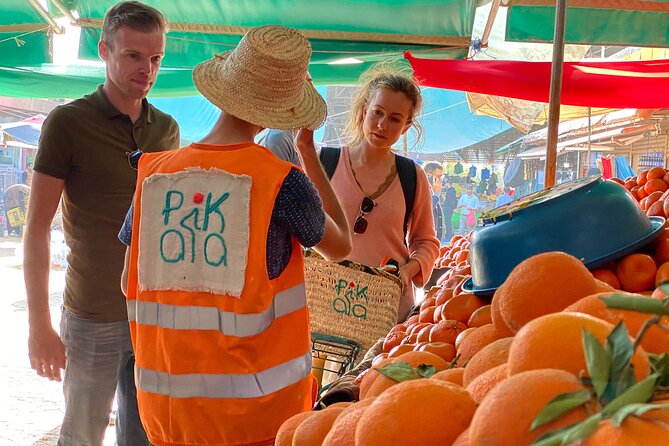
Then there’s the market side: you’ll pick up fresh fruits from the Main City Market. In practice, that often feels like the most comfortable cultural moment because you can ask simple questions—what’s good today, what people recommend, what you should buy for eating later. You don’t need a long attention span for it; you just need curiosity.
Souk El Had and Talborjt: Shopping Streets With an Actual Point
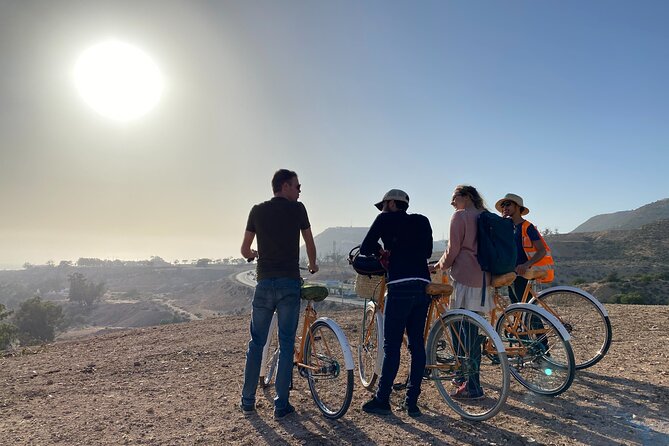
Two parts of the ride connect you to the city’s commercial pulse: Souk El Had d’Agadir and Talborjt.
Souk El Had d’Agadir: A Market You Can Use, Not Just Look At
You’ll spend around 20 minutes at Souk Al Had. It’s described as a busy market in the heart of Agadir, known for a mix of crafts, textiles, jewelry, spices, and fresh produce. This is where the tour stops being only cultural interpretation and becomes sensory street time.
Souks are also practical. If you want a souvenir that feels less touristy, or you want to taste what you see, this is the kind of stop where you can make quick decisions. And with the fruit included in the tour concept, you might actually leave with something you’ll eat right away.
Quartier Industriel: The Entrepreneur Story Behind the Streets
There’s also a stop in the industrial zone (Quartier Industriel), about 20 minutes. The tour highlights the resilience story of an entrepreneur who began making handmade shoes using traditional Moroccan techniques. The business grew, hired more staff, expanded product lines, and eventually started exporting.
You don’t need to be a business student to appreciate what this adds. It answers the unspoken question: what does rebuilding and modernization look like at ground level? This stop gives you a human-scale version of that story.
Talborjt: Shops, Cafes, and Near-By Landmarks
Talborjt is described as a lively district with shops, cafes, and restaurants, where locals and visitors fill the streets day and night. Expect time to absorb the atmosphere, browse if you want, and understand why this area feels like a day-long social hub.
The info also mentions historic landmarks tied to the district, including Agadir Oufella fortress and the Musée Municipal du Patrimoine Amazigh. The tour data doesn’t promise you’ll enter those specific sites, but even knowing they’re part of the neighborhood context helps you connect this stop to future sightseeing.
Royal Palace Grounds and Bank Al-Maghrib Facades
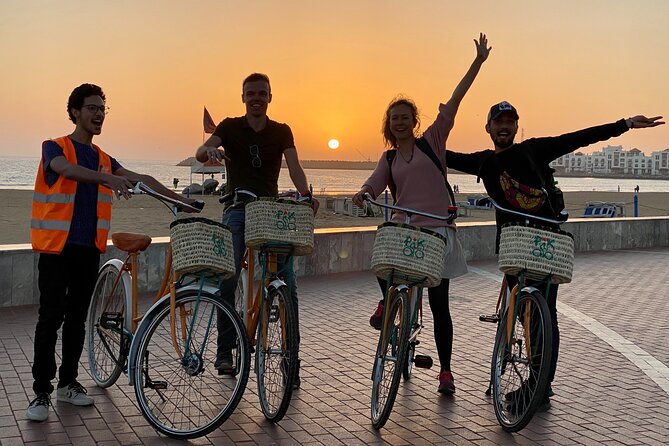
Two later stops shift the theme to how Agadir presents itself to the world: official architecture and high-profile spaces.
The Royal Palace Grounds: Closed to the Public, Still Worth Noticing
You’ll stop by the royal palace area. It’s described as closed to the public, but the grounds include a huge green park for residents. The info explains it was built by a former Saudi minister of defence, later given as a gift to King Mohammed VI, and then turned into a luxury tourist resort by 2007.
Even though you can’t enter, you’ll likely get views toward the waterfront area that’s described as attractive to Moroccan tourists, foreigners, and sports enthusiasts. The value here is perspective. You’re seeing how the city frames prestige, leisure, and location along the coast.
Bank Al-Maghrib: Second Branch, Modern Reconstruction, Artistic Touch
You’ll also stop at the current Bank Al-Maghrib, described as built after reconstruction in the 1980s by architect Élie Azagury. It’s said to be the second Bank Al-Maghrib in Agadir because the first was abandoned after the earthquake.
One detail I like: the info says Élie Azagury would have called famous painters and designers to add an artistic touch. Even if you only get a short look, that kind of design-forward approach makes the stop feel less generic. You’re seeing how public finance spaces were treated as part of the city’s visual identity.
Riding Tips That Make the Whole Tour Work
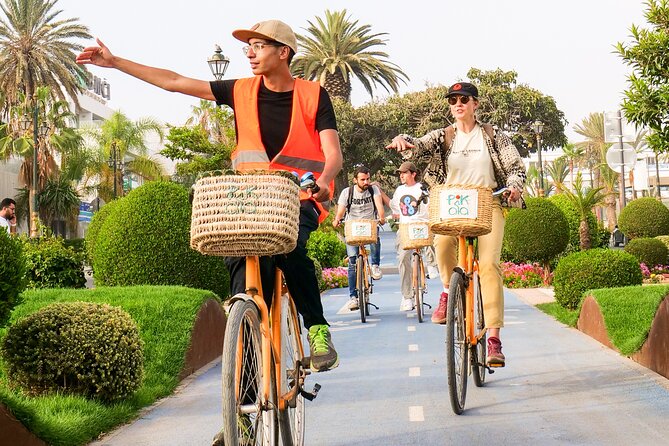
A bike tour is only as good as the coordination. And here’s where I’ll connect the dots to one caution from the experience: a guide losing track of someone at traffic lights is a reminder that group management is everything.
Here’s what I recommend you do to protect your own experience:
- Stay close to the guide and keep an eye on the group line at every stop.
- If you’re ever separated even briefly, treat it like a priority problem and rejoin quickly before the tour moves on.
- At each landmark, do a quick mental headcount and watch for the moment the guide starts signaling the move to the next stop.
On a practical level, since helmets or hats are provided, you’re covered for basic safety. Still, wear shoes that grip and clothes you don’t mind getting dusty—Agadir streets can be sun-bright and busy.
Finally, remember this tour blends religious and civic spaces. When you approach places like Mosquee Mohamed V, your job is to be respectful and mindful of etiquette. That’s part of why the stops feel meaningful rather than rushed.
Who This Agadir Electric Bike Tour Suits Best
This tour is a good fit if you want:
- A first-time orientation to Agadir that connects street life to landmark architecture
- A way to see more than one neighborhood without tiring yourself out
- Fun, guided conversation about modern Morocco—family, religion, and change
- A small group pace that leaves room to ask questions
It’s not ideal if you hate any city-bike motion, or if you need long time inside buildings. Several stops are brief and mostly exterior or look-and-learn based.
Should You Book Pikala’s Electric Bike Tour of Agadir?
I think this is worth booking if you like guided city context, enjoy the electric bike format, and want a route that mixes mosques, earthquake-era design, markets, and real everyday stops like bakery and cafe time. The included snacks, water, and coffee or tea make it feel complete, not just transportation with a couple of photos.
I’d book with one mindset adjustment: keep close to your guide and don’t let yourself drift at crossings. The tour sounds well-run overall (with strong positive feedback on friendliness and the fun of seeing the city while staying active), but that one caution is enough to justify taking responsibility for your own position.
If it’s your first visit to Agadir and you want a lively, human introduction in only 3 hours, this is a solid choice.
FAQ
How long is the Agadir electric bike tour?
The tour runs for about 3 hours.
What does the tour cost?
The price is $32.98 per person.
Where do I meet, and where does the tour end?
You meet at Banque Populaire (CC72+74C), Agadir 80000, Morocco, and the tour ends back at the same meeting point.
What’s included in the price?
Included are snacks, bottled water, coffee and/or tea, use of the bicycle, and a helmet or hats.
Do I get picked up from my hotel?
No. Hotel pick up and drop off are not included.
Do we go inside the synagogue?
No. You stop by the Agadir Synagogue without going in.
Is cancellation free?
Yes. You can cancel up to 24 hours in advance for a full refund.